
What Is Crypto Mining? How Bitcoin Mining Works (Beginner’s Guide)
Short answer: crypto mining is the process that adds new transactions to a proof-of-work blockchain such as Bitcoin. Miners run specialized computers that repeatedly hash block data until one of them finds a result below a network target. The winner adds the next block and receives the block reward plus transaction fees. Today, almost all Bitcoin mining is done with ASIC miners, machines built to do one type of calculation as efficiently as possible.
This guide explains how mining works step by step, what equipment and power it takes, how mining pools work, and what to think about before you buy a miner. It does not predict earnings: mining results change daily with network difficulty, coin prices and electricity costs.
What does “mining” actually do?
Bitcoin has no central company approving payments. Instead, thousands of computers keep a shared ledger, the blockchain. Mining solves two problems at once:
- Ordering transactions. Miners collect pending transactions into a candidate block. Once a valid block is found and accepted, the transactions in it are confirmed.
- Making the history expensive to rewrite. Finding a valid block takes a huge amount of computation. To change past blocks, an attacker would have to redo that work faster than the rest of the network, which is what makes confirmed transactions secure.
In return for this work, the miner who finds a block receives newly created bitcoin (the block subsidy) and the fees paid by the transactions in that block.
How Bitcoin mining works, step by step
- Build a candidate block. A miner (or, more often, a mining pool) gathers pending transactions and a reference to the previous block.
- Hash the block header. The header is run through the SHA-256 hash function (twice). The output is a 256-bit number that looks random.
- Compare against the target. The network sets a target. If the hash is below the target, the block is valid. If not, the miner changes a small field called the nonce (and other adjustable data) and tries again.
- Repeat trillions of times per second. There is no shortcut: finding a valid hash is pure trial and error. A modern ASIC miner performs hundreds of trillions of hashes per second, which is why hashrate is measured in terahashes per second (TH/s).
- Broadcast the block. When a miner finds a valid hash, it sends the block to the network. Other nodes check it and, if it is valid, start building on top of it.
- Collect the reward. The winning miner’s reward address receives the block subsidy and transaction fees.
Block reward, halvings and difficulty
A new Bitcoin block is found roughly every 10 minutes. Two rules keep that pace and control supply:
- Halvings. The block subsidy is cut in half every 210,000 blocks, roughly every four years. Since the April 2024 halving, the subsidy is 3.125 BTC per block. The next halving is expected around 2028.
- Difficulty adjustment. Every 2,016 blocks (about two weeks), the network adjusts the difficulty so blocks keep arriving about every 10 minutes. When more machines join, difficulty rises and each machine’s share of the rewards shrinks.
This is the single most important fact for anyone buying a miner: your machine’s hashrate stays the same, but its share of the network shrinks as others add hashrate. That is why efficiency, measured in joules per terahash (J/TH), matters so much. More efficient machines stay useful for longer.
What equipment do you need?
ASIC miners
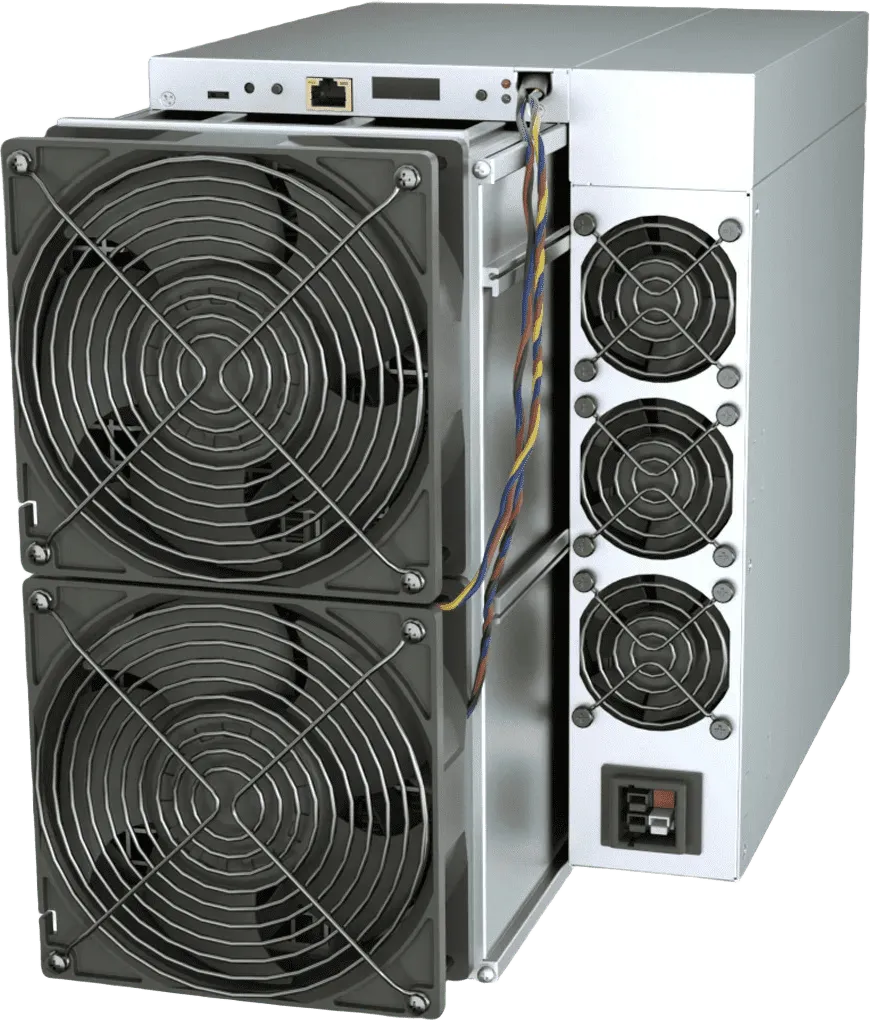
Bitcoin is mined with ASIC miners (application-specific integrated circuits). CPUs and graphics cards are no longer practical for Bitcoin because ASICs are many thousands of times more efficient at SHA-256. Read our guide What Is an ASIC Miner? for how they work, or browse Bitcoin (SHA-256) miners.
Power
Most full-size air-cooled miners draw about 3,000 to 3,700 watts and need a 200–240 V circuit. Hydro-cooled units can draw 5,000 to 11,000 watts or more and are designed for facilities with liquid cooling and high-capacity power. Almost every watt a miner uses turns into heat, so plan for ventilation or heat reuse.
Cooling and noise
Air-cooled miners are loud (often 70–80 dB, similar to a vacuum cleaner) and push out a lot of hot air. Hydro and immersion miners are quieter at the machine but need pumps, radiators or tanks. For a home or office, look at home and solo miners, which are small and quiet but far less powerful.
Internet and a pool account
Miners need a stable wired internet connection and an account with a mining pool (or solo mining setup). Bandwidth needs are small.
Mining pools vs solo mining
A single machine has an extremely small chance of finding a Bitcoin block on its own. Most miners therefore join a mining pool, which combines the hashrate of many participants and shares rewards according to how much work each one contributes. Pools charge a fee, usually a few percent, and use payout methods such as FPPS or PPLNS that smooth out income.
Solo mining means pointing your hardware at your own node or a solo pool and keeping the whole reward if you find a block. With small hardware it works like a lottery ticket: the chance of a block on any given day is tiny. Our Bitaxe and solo mining guide explains the odds.
Costs to consider before you start
- Hardware: the purchase price of the miner, plus shipping.
- Electricity: usually the largest ongoing cost. A 3,500 W miner running 24 hours uses 84 kWh per day.
- Infrastructure: wiring, circuits, ventilation or cooling, and sound control.
- Pool fees and taxes: pool fees reduce payouts, and mined coins are generally taxable income in the US. See Is Crypto Mining Legal in the US?
- Change over time: difficulty, coin prices, transaction fees and the next halving all change the numbers.
Our ASIC miner profitability guide shows how to estimate revenue and electricity cost with your own inputs. Bitminers does not guarantee mining profitability or return on investment.
Other coins you can mine
Bitcoin uses SHA-256, but other proof-of-work networks use different algorithms and need different ASICs:
| Coin | Algorithm | Example hardware |
|---|---|---|
| Bitcoin (BTC) | SHA-256 | Antminer S21, Whatsminer M-series |
| Litecoin (LTC) and Dogecoin (DOGE) | Scrypt | Antminer L9, ElphaPex DG1 |
| Kaspa (KAS) | kHeavyHash | Antminer KS7, IceRiver KS-series |
| Ethereum Classic (ETC) | Etchash | Jasminer X16, Antminer E9 |
| Alephium (ALPH) | Blake3 | Antminer AL1, Goldshell AL Box |
Frequently asked questions
Can I mine Bitcoin on my computer or phone?
Technically yes, but a computer or phone contributes so little hashrate compared with ASIC miners that it is not practical. Apps that claim to let you “mine Bitcoin” on a phone are usually rewards or cloud-mining schemes, not real mining.
How long does it take to mine one bitcoin?
There is no fixed time. In a pool, each machine earns a small share of the rewards proportional to its hashrate, so a single miner earns a fraction of a bitcoin over time. That fraction depends on network difficulty, which changes about every two weeks.
Is mining bad for the environment?
Mining uses a lot of electricity. Its impact depends on the energy source. Many operations use surplus, stranded or renewable power, and some reuse the heat. More efficient machines use less energy per terahash.
Where can I buy a Bitcoin miner in the US?
Bitminers sells new ASIC miners with flat-rate US shipping of $120 per order, a 30-day limited warranty and 20-day returns. Browse all miners or read the ASIC miner buyers guide.