
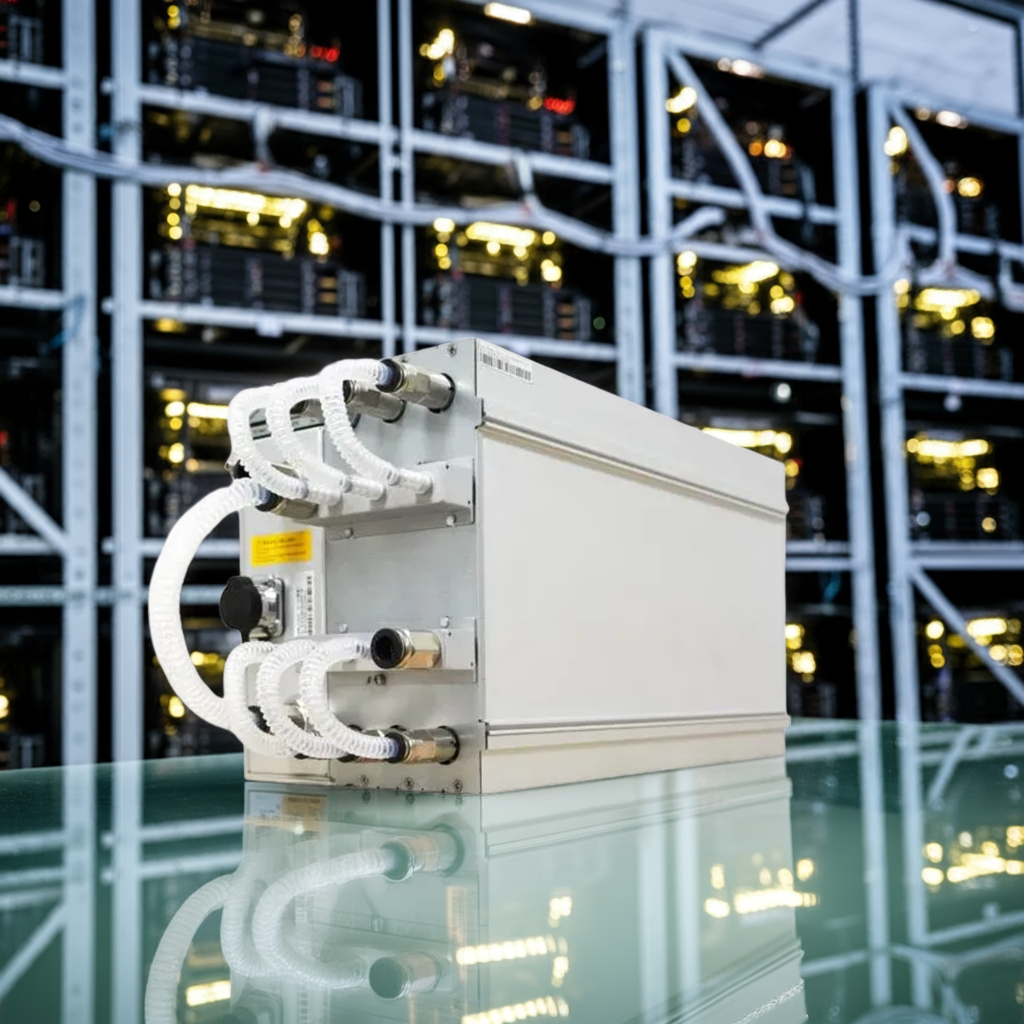
What Is an ASIC Miner? How ASIC Mining Hardware Works
Short answer: an ASIC miner is a computer built around chips designed for one job: running a single mining algorithm, such as SHA-256 for Bitcoin, as fast and as efficiently as possible. “ASIC” stands for application-specific integrated circuit. Because the chips do only one thing, ASIC miners are far more efficient than CPUs or graphics cards, but they cannot switch to a different algorithm.
This guide covers what is inside an ASIC miner, how to read its specifications, the cooling types, what the different algorithms mean, and how to run one safely.
ASIC vs CPU vs GPU
Bitcoin was first mined on ordinary computer processors (CPUs), then on graphics cards (GPUs), then briefly on programmable chips (FPGAs). The first Bitcoin ASIC miners shipped in 2013, and within a few years they made every other kind of hardware uncompetitive for Bitcoin.
| CPU | GPU | ASIC | |
|---|---|---|---|
| Designed for | General computing | Parallel graphics and compute | One hashing algorithm |
| Can change algorithm | Yes | Yes | No |
| Efficiency on its target algorithm | Very low | Low | Highest |
| Practical for Bitcoin today | No | No | Yes |
What is inside an ASIC miner?
- Hashboards: most full-size miners have three boards, each carrying dozens of ASIC chips. They do the actual hashing.
- Control board: a small computer that connects to the network, runs the firmware and web dashboard, and sends work to the hashboards.
- Power supply (PSU): converts mains power, usually 200–240 V AC, to the low voltage the boards need. Many hydro models run on higher-voltage or three-phase power.
- Cooling: fans on air-cooled models; water plates on hydro models; nothing at all on immersion models, which sit in dielectric fluid.
How to read ASIC miner specifications
| Spec | What it means | Why it matters |
|---|---|---|
| Hashrate | Calculations per second, e.g. 270 TH/s (terahashes) for Bitcoin or 16 GH/s (gigahashes) for Scrypt | Your share of the network’s work, and therefore of rewards |
| Power consumption | Watts drawn at the wall, e.g. 3,645 W | Sets your electricity cost and circuit requirements |
| Efficiency | Joules per terahash (J/TH): power divided by hashrate | The best single number for comparing Bitcoin miners; lower is better |
| Algorithm | SHA-256, Scrypt, kHeavyHash, Etchash and so on | Decides which coins the machine can mine |
| Cooling | Air, hydro (water) or immersion | Decides the infrastructure you need |
| Noise | Usually 70–80 dB for air-cooled units | Air-cooled miners are too loud for living spaces |
| Input voltage | Typically 200–240 V; some hydro units need 380–415 V | Most US homes need a dedicated 240 V circuit |
Example: an Antminer S21 XP rated at 270 TH/s and 3,645 W works out to 3,645 ÷ 270 = 13.5 J/TH. An older machine at 30 J/TH uses more than twice as much electricity for the same hashrate.
Air, hydro and immersion cooling
- Air-cooled miners are the simplest to install: plug in power and Ethernet. They are loud and need a lot of airflow. Example: Antminer S21 and S21 XP.
- Hydro-cooled miners circulate water or coolant through plates on the hashboards. They reach higher hashrates and efficiencies but need pumps, radiators or dry coolers. Example: Antminer S23 Hydro.
- Immersion miners sit in tanks of non-conductive fluid. They run quietly and cool evenly but require tanks, fluid and heat exchangers.
For a deeper comparison see Air Cooling vs Hydro Cooling.
Algorithms and the coins ASIC miners can mine
| Algorithm | Coins | Shop |
|---|---|---|
| SHA-256 | Bitcoin (BTC), Bitcoin Cash (BCH) | Bitcoin miners |
| Scrypt | Litecoin (LTC), Dogecoin (DOGE) | Litecoin & Dogecoin miners |
| kHeavyHash | Kaspa (KAS) | Kaspa miners |
| Etchash | Ethereum Classic (ETC) | ETC miners |
| Blake3 | Alephium (ALPH) | Alephium miners |
| Aleo PoW | Aleo | Aleo miners |
A miner can only mine coins that use its algorithm. A Bitcoin ASIC cannot mine Litecoin, and a Scrypt ASIC cannot mine Bitcoin.
Who makes ASIC miners?
The largest manufacturers are Bitmain (Antminer), MicroBT (Whatsminer) and Canaan (Avalon). Others include IceRiver, Goldshell, ElphaPex, VolcMiner and Bitdeer (SealMiner).
Running an ASIC miner safely
- Electrical: use a dedicated circuit sized for continuous load. Under the US National Electrical Code, continuous loads should not exceed 80% of a breaker’s rating. Have a licensed electrician check your wiring.
- Heat: every watt becomes heat. A 3,500 W miner gives off roughly 12,000 BTU per hour, about as much as a large space heater. Plan exhaust or heat reuse.
- Noise: air-cooled miners belong in a garage, shed, basement with sound treatment, or a dedicated facility, not a living space.
- Dust and humidity: filter intake air and keep humidity moderate to protect the boards.
- Firmware: use the manufacturer’s firmware or reputable alternatives, and change the default password.
Frequently asked questions
How long does an ASIC miner last?
Hardware often runs for several years when cooled and powered properly. In practice, a miner’s useful life is usually limited by efficiency: as newer, more efficient machines join the network, older models earn a smaller share of rewards relative to their power use.
Can I run an ASIC miner at home?
Full-size air-cooled miners are too loud and hot for most homes and need a 240 V circuit. Compact models such as the Avalon Nano or a Bitaxe run on a standard outlet. See home and solo miners.
Is an ASIC miner a good investment?
Bitminers does not give investment advice or guarantee profitability. Results depend on electricity costs, network difficulty and coin prices. Use our profitability guide and calculator with your own numbers before buying.
How do I choose a miner?
Start with the algorithm (which coin), then compare efficiency (J/TH), the power and cooling you can provide, and noise. Our best ASIC miners comparison and buyers guide walk through it.