
Bitaxe Explained: Is a Solo Home Bitcoin Miner Worth It?
Short answer: a Bitaxe is a small, open-source Bitcoin miner about the size of a paperback that uses a single Bitmain ASIC chip, runs on a 5 V power supply and connects over Wi-Fi. Current versions such as the Bitaxe Gamma produce around 1.2 TH/s on roughly 15–20 W. It is quiet, cheap to run and great for learning, but it is not a way to earn meaningful income: in solo mode, the chance of finding a Bitcoin block is extremely small.
What is a Bitaxe?
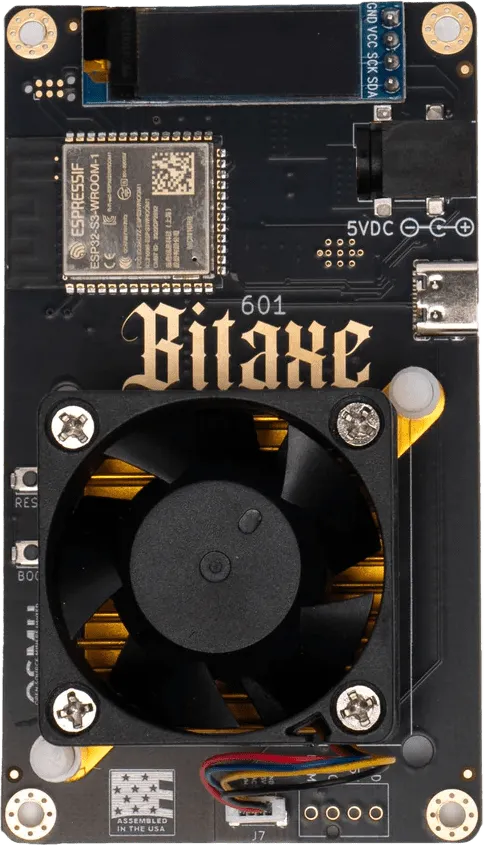
The Bitaxe is an open-source hardware project: its circuit board designs and firmware (called AxeOS) are published for anyone to build, audit or improve. Several manufacturers produce Bitaxe boards and compatible designs. Each unit pairs a Bitmain SHA-256 ASIC chip with an ESP32 controller, a heatsink and a small fan. You configure it from a web page on your local network, point it at a pool, and it starts hashing.
Bitaxe models at a glance
| Model | ASIC chip | Typical hashrate |
|---|---|---|
| Bitaxe Ultra | BM1366 | about 0.5 TH/s |
| Bitaxe Supra | BM1368 | about 0.6–0.7 TH/s |
| Bitaxe Gamma | BM1370 | about 1.2 TH/s |
Figures are typical stock settings; individual units vary. Multi-chip designs such as the NerdQaxe++ (about 4.8 TH/s) scale the same idea up.
Solo mining: how the odds work
Most miners join pools that share rewards. Bitaxe owners often choose solo mining instead: the device works alone, and if it ever finds a valid block, its owner receives the whole block reward (3.125 BTC plus fees since the 2024 halving).
The catch is probability. Your chance of finding each block is your hashrate divided by the network’s hashrate. In 2025–2026 the Bitcoin network runs at close to a billion terahashes per second. A 1.2 TH/s Bitaxe is therefore roughly one part in a billion of the network. With about 144 blocks per day, that works out to an expected wait of many thousands of years per device. Blocks found by tiny solo setups do happen occasionally, and they make headlines precisely because they are so rare.
Think of solo mining with a Bitaxe as a lottery ticket that also teaches you how Bitcoin mining works, not as an income source.
Pool mining with a Bitaxe
You can point a Bitaxe at an ordinary pool instead. It will then earn a small, steady share of rewards proportional to its hashrate. At about 1.2 TH/s that share is tiny, and some pools have minimum payout thresholds that take a long time to reach with such low hashrate.
Why people buy a Bitaxe
- Learning: it is the cheapest way to see pools, hashrate, difficulty and firmware in practice.
- Open source: you can inspect and modify the hardware and firmware.
- Quiet and low power: it runs on a desk from a standard outlet and draws about as much power as a phone charger or two.
- Supporting decentralization: more independent miners building their own block templates is healthy for the network.
- The lottery: a small chance at a full block reward.
Setting up a Bitaxe
- Connect the included or recommended 5 V power supply. Don’t substitute an underpowered adapter.
- Join the Bitaxe’s temporary Wi-Fi network from your phone or laptop and enter your home Wi-Fi details.
- Open the AxeOS dashboard at the device’s local IP address.
- Enter a pool address. For solo mining, use a solo pool and your own Bitcoin address as the username.
- Keep the default frequency and voltage at first. Overclocking raises heat and power draw.
Other home miners to consider
| Miner | Hashrate | Power | Notes |
|---|---|---|---|
| Bitaxe Gamma 601 | 1.2 TH/s | about 15–20 W | Open source, desk-size |
| NerdQaxe++ | 4.8 TH/s | see product page | Multi-chip open-source design |
| Avalon Nano 3s | 6 TH/s | 140 W | Quiet, doubles as a small heater |
| Avalon Q | 90 TH/s | 1,674 W | Largest home-class miner, needs a dedicated circuit |
See all home and solo miners, or compare full-size machines in Best ASIC Miners.
Frequently asked questions
Is a Bitaxe worth it?
It is worth it as a learning tool and a low-cost, low-power way to take part in Bitcoin mining. It is not worth buying for income; Bitminers does not guarantee any mining result.
How much electricity does a Bitaxe use?
A Bitaxe Gamma typically draws about 15–20 W. Running it 24 hours a day uses roughly 0.35–0.5 kWh.
Has a Bitaxe ever found a block?
Very small solo miners have occasionally found blocks, which is why solo mining is compared to a lottery. The odds for any single device remain extremely low.
Is a Bitaxe loud?
No. It has one small fan and is quiet enough for a desk, unlike full-size ASIC miners at 70–80 dB.
Where can I buy a Bitaxe in the US?
Bitminers sells the Bitaxe Gamma 601 new, with flat-rate US shipping of $120 per order, a 30-day limited warranty and 20-day returns.