
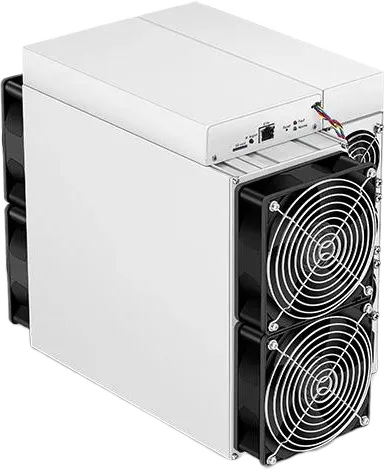
Scrypt Miners Explained: Antminer L7, L9, L11, ElphaPex and VolcMiner
Short answer: a Scrypt ASIC miner is a machine built to run the Scrypt proof-of-work algorithm used by Litecoin and Dogecoin. Because the two coins are merge-mined, one Scrypt miner works on both at once. Current data-center models such as the Antminer L9 (16 GH/s at 3,360 W) and Antminer L11 (20 GH/s at 3,680 W) are rated around 0.18-0.21 J/MH, and Bitmain’s hydro versions reach 27-35 GH/s per unit. Home-class Scrypt units draw roughly 280 W to 1.8 kW.
This guide explains what Scrypt is, compares the Scrypt miners we list by rated hashrate, power, efficiency and cooling, and shows how air, hydro and home-class units differ. Bitminers does not guarantee mining profitability.
What Scrypt is
Scrypt is a password-based key derivation function created by Colin Percival and specified in RFC 7914. It is memory-hard: computing it needs a block of memory as well as raw arithmetic, which was meant to make custom hardware less of an advantage. Litecoin adopted Scrypt for proof of work, and Dogecoin uses it too.
Memory-hard did not mean ASIC-proof. Dedicated Scrypt chips now do the work far more efficiently than graphics cards, which is why every machine in this guide is an ASIC. A Scrypt miner cannot mine Bitcoin (SHA-256) or Kaspa (kHeavyHash); it only works on Scrypt coins.
Litecoin and Dogecoin: one miner, two coins
Dogecoin accepts Litecoin proof of work through merged mining, so a Scrypt miner pointed at a pool that supports it contributes to both chains with the same hashing. Your hashrate does not double, and how the two coins are paid out depends on the pool. Our guide to merged mining Litecoin and Dogecoin covers how it works. Makers also list smaller Scrypt coins for these machines; Bitmain, for example, lists BEL, JKC, LKY and PEP alongside LTC and DOGE.
Reading Scrypt hashrate and J/MH
Scrypt hashrate is quoted in megahashes (MH/s) or gigahashes (GH/s) per second, where 1 GH/s equals 1,000 MH/s. An Antminer L7 rated at 9,500 MH/s therefore does 9.5 GH/s. Efficiency is written in joules per megahash (J/MH) or joules per gigahash (J/GH): power in watts divided by hashrate. 210 J/GH is the same as 0.21 J/MH, and a lower number means less electricity for the same work. Our guide to hashrate units and efficiency explains the arithmetic in more detail.
Data-center Scrypt ASIC miners compared
The table lists the rated figures for each data-center Scrypt model we carry. Bitmain, ElphaPex and FluMiner ratings come from the makers’ own pages. Where a maker publishes no figures (marked *), the table uses ratings from independent spec databases that agree with each other. Where a model ships in several hashrate bins, the table shows the range.
| Model | Rated hashrate | Power | Efficiency | Cooling |
|---|---|---|---|---|
| Antminer L7 | 7.8-9.5 GH/s | 2,810-3,420 W | 0.36 J/MH | Air |
| Antminer L9 | 16 GH/s | 3,360 W | 0.21 J/MH | Air |
| Antminer L11 | 20 GH/s | 3,680 W | 0.184 J/MH | Air |
| ElphaPex DG1+* | 14 GH/s | 3,920 W | 0.28 J/MH | Air |
| ElphaPex DG1 Lite* | 11 GH/s | 3,410 W | 0.31 J/MH | Air |
| ElphaPex DG2 | 17.5 GH/s | 3,850 W | 0.22 J/MH | Air |
| ElphaPex DG2+* | 20.5 GH/s | 3,900 W | 0.19 J/MH | Air |
| VolcMiner D1* | 15.15-18.5 GH/s | 3,450-4,250 W | 0.23 J/MH | Air |
| VolcMiner D3* | 20 GH/s | 3,580 W | 0.179 J/MH | Air |
| Goldshell DG MAX* | 6.5 GH/s | 3,400 W | 0.52 J/MH | Air |
| iBeLink BM-L3* | 3.2 GH/s | 3,000 W | 0.94 J/MH | Air |
| Antminer U2L9H | 27 GH/s | 5,670 W | 0.21 J/MH | Hydro, 2U |
| Antminer L11 Hyd 2U | 35 GH/s | 5,775 W | 0.165 J/MH | Hydro, 2U |
| Antminer L11 Hyd 6U | 33 GH/s | 5,676 W | 0.172 J/MH | Hydro, 6U set |
| ElphaPex DG Hydro 1 | 20 GH/s | 6,200 W | 0.31 J/MH | Hydro |
| VolcMiner D1 Hydro* | 30-33 GH/s | 7,600-9,300 W | 0.25-0.28 J/MH | Hydro |
Notes: Bitmain publishes a single 16 GH/s rating for the L9 on its L9 specifications page; spec databases also list a 17 GH/s bin at 3,570 W. Spec databases list the ElphaPex DG2 at 18 GH/s and 3,960 W; the maker currently lists 17.5 GH/s. Bitmain rates the L9 at 75 dBA and the L11 at 76 dBA, and spec databases list 70-75 dB for the L7 and the other air-cooled models.
Two things stand out. The Antminer L7 (2021) is the older generation, and its 0.36 J/MH is well behind the L9 and L11. And efficiency varies widely between makers: the iBeLink BM-L3 draws almost as much power as an L9 for a fifth of the hashrate.
Air vs hydro Scrypt miners
The air-cooled models are the familiar box with fans on a standard AC supply: Bitmain specifies 220-277 V for the L9 and L11 (single-phase for the L11), and ElphaPex specifies 200-240 V for the DG2. At about 3.4-4.3 kW each, one unit needs a dedicated circuit sized for continuous load.
The hydro models are a different class of equipment:
- Three-phase power: Bitmain specifies 380-415 V three-phase for the U2L9H and 380-480 V three-phase for both L11 Hyd units. ElphaPex specifies 380-480 V for the DG Hydro 1.
- Coolant loop: Bitmain lists 8-10 L/min of coolant flow for the U2L9H and L11 Hyd 2U, and 12 L/min for the L11 Hyd 6U, with ratings quoted at 35 °C inlet coolant.
- Rack format: the U2L9H is a 2U rack-mount hydro version of the L9, which spec databases call the L9 Hyd 2U. Bitmain ships the L11 Hyd 6U as a set of a 2U unit and a 4U unit.
Hydro units pack more hashrate into each slot and move heat into water instead of room air, but they only make sense on a site that already has three-phase service and a cooling loop, or a hydro container. Air-cooled units remain the simpler choice for a site without that infrastructure.
Home-class Scrypt miners
A newer group of Scrypt machines is built for a standard household outlet. They trade hashrate for lower power and noise:
| Model | Rated hashrate | Power | Input | Rated noise |
|---|---|---|---|---|
| FluMiner L2 | 1.2 GH/s | 280 W | 110-240 V | up to 40 dB |
| FluMiner L1 | 5.6 GH/s (5.3 GH/s at launch) | 1,300 W (1,200 W) | 110-240 V | about 45 dB |
| FluMiner L1 Pro | 6 GH/s | 1,400 W | 110-240 V | up to 45 dB |
| ElphaPex DG Home 1 | 2.1 GH/s | 630 W | 100-240 V | 50 dB* |
| VolcMiner D1 Mini* | 2.2 GH/s | 500 W | not stated | 55 dB |
| Goldshell Mini-DOGE III* | 650-700 MH/s | 400 W | 100-240 V | 35 dB |
| Goldshell E-DG1M* | 3.4 GH/s | 1,800 W | not stated | 45 dB |
The FluMiner and ElphaPex figures are the makers’ ratings (the DG Home 1 noise figure is from spec databases); entries marked * come from spec databases. VolcMiner sells the D1 Mini as the “D1 Mini Pre”. ElphaPex lists the DG Home 1’s cooling as hydro, so it is not a fan-only box.
Home-class does not mean low efficiency: the FluMiner L1 Pro and L2 are both rated at 0.23 J/MH, close to the data-center VolcMiner D1. The difference is scale. A 1,400 W unit draws roughly 11.7 A at 120 V, which still needs a circuit that can carry it continuously.
Scrypt miners on Bitminers
All of our Litecoin and Dogecoin machines are in the Scrypt miners category, with the Bitmain families on the Antminer L9 and Antminer L7 pages and the other makers on the ElphaPex and VolcMiner brand pages. A selection at the time of writing (October 4, 2026):
- Antminer L9, 16 GH/s (air): $3,199.00
- Antminer L11, 20 GH/s (air): $7,499.00
- Antminer U2L9H, 27 GH/s (hydro): $5,903.95
- FluMiner L1 Pro, 6 GH/s (home class): $1,551.77
- ElphaPex DG Home 1, 2.1 GH/s (home class, hydro-cooled): $510.25
Compare models on J/MH, the power and cooling your site can supply, noise limits and purchase price, and use current network and coin data rather than fixed estimates. Bitminers does not guarantee mining profitability.
Frequently asked questions
Can a Scrypt miner mine Bitcoin?
No. Bitcoin uses SHA-256, and a Scrypt ASIC only runs Scrypt. It works on Litecoin, Dogecoin and other Scrypt coins.
What is the difference between the Antminer L7 and L9?
The L9 is the newer generation. Bitmain rates the L7 at 7.8-9.5 GH/s and 0.36 J/MH, and the L9 at 16 GH/s and 0.21 J/MH, with similar power draw (up to 3,420 W vs 3,360 W).
Is the Antminer L11 more efficient than the L9?
Yes, on Bitmain’s ratings. The air-cooled L11 is rated at 20 GH/s and 0.184 J/MH against 0.21 J/MH for the L9, and the hydro L11 Hyd 2U reaches 0.165 J/MH.
What is the difference between the ElphaPex DG1 and DG2 series?
The DG2 series is newer and more efficient: about 0.19-0.22 J/MH for the DG2 and DG2+, against 0.28-0.31 J/MH for the DG1+ and DG1 Lite.
Do I need three-phase power for a Scrypt miner?
Only for the hydro models. Air-cooled units such as the L9, L11 and ElphaPex DG2 run on 200-277 V AC, and the home-class units in this guide are specified for 100-240 V or 110-240 V where the maker states it.