
Crypto Mining Rig: GPU Rigs vs ASIC Miners Explained
A crypto mining rig is the hardware you run to mine a proof-of-work coin. Two kinds exist: a GPU rig, several graphics cards on an open frame driven by one computer, and an ASIC miner, a purpose-built box for one algorithm. Bitcoin uses ASICs today, so a Bitcoin rig is an ASIC plus power, cooling, network, pool account and wallet.
This guide explains both kinds of rig, why Bitcoin moved to ASICs, what a complete ASIC setup includes and how setups scale from a desk unit to a container. If you are new to the topic, start with what crypto mining is and come back here for the hardware side.
What is a mining rig?
“Mining rig” is a general term for any machine, or group of machines, set up to mine cryptocurrency around the clock. The word comes from the do-it-yourself era, when miners built their own frames and wired cards together. Today it covers everything from a homemade multi-card frame to a factory-built ASIC miner that arrives ready to plug in. What all rigs share is the job: running a coin’s hashing algorithm as many times per second as possible, for as little electricity as possible.
What is a GPU mining rig?
A GPU rig is built from general-purpose computer parts:
- Graphics cards. Usually several cards, connected to the motherboard with riser cables so they can be spaced out for airflow.
- Frame. An open metal frame that holds the cards in a row, with fans moving air across them.
- Motherboard, CPU, memory and storage. A basic computer that runs the operating system and mining software.
- Power supplies. One or more PC power supplies sized for the combined draw of all the cards.
The strength of a GPU rig is flexibility. Graphics cards are general-purpose, so the same rig can switch to a different algorithm by changing software, and the cards keep resale value outside mining. The trade-off is efficiency: a graphics card does far less work per watt on a given algorithm than an ASIC built for it. GPU rigs also lost a major use when Ethereum, whose proof of work was secured by hash power such as GPUs, completed its move to proof of stake on September 15, 2022. Ethereum Classic kept proof of work, and its project notes that its algorithm is almost identical to Ethereum’s former one, so it supports the same hardware.
What is an ASIC mining rig?
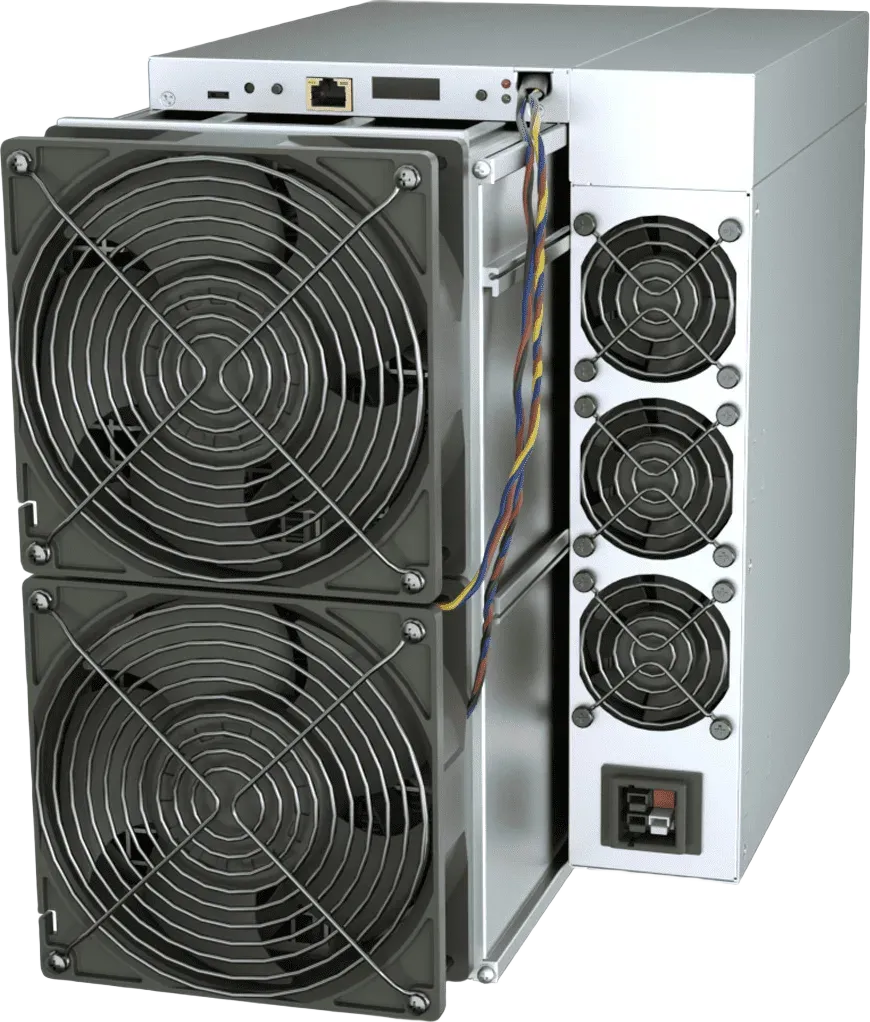
An ASIC (application-specific integrated circuit) miner is one sealed unit:
- Hashboards full of chips designed for a single algorithm.
- A control board that runs the firmware and web dashboard.
- A power supply.
- Built-in cooling.
You do not assemble anything. You connect power and Ethernet, enter your pool details and it starts hashing. The trade-off is the opposite of a GPU rig: an ASIC is far more efficient on its algorithm but cannot mine anything else. A SHA-256 miner mines Bitcoin and other SHA-256 coins only. Our guide What Is an ASIC Miner? covers the internals and how to read the specs.
| GPU rig | ASIC miner | |
|---|---|---|
| Build | Assembled from cards, frame, motherboard and PC power supplies | Single factory-built unit |
| Algorithms | Can switch by changing software | One algorithm only |
| Work per watt on its algorithm | Lower | Much higher |
| Setup | Install OS, drivers and mining software | Plug in power and network, enter pool details |
| Practical for Bitcoin today | No | Yes |
Why does Bitcoin mining use ASICs?
Bitcoin’s proof of work is the SHA-256 hash function, and the network adjusts difficulty so that blocks keep arriving at a steady pace as more hashrate joins. The Bitcoin project’s FAQ notes that in the early days anyone could find a new block with a computer’s CPU, but that as difficulty rose, the only cost-effective method of mining today is specialized hardware. Once SHA-256 ASICs existed, every CPU and GPU still on the network was competing against machines doing vastly more hashes for each watt. Its share of the work fell below the cost of the electricity it used. That is why a “Bitcoin mining rig” today means one or more SHA-256 ASIC miners, and why GPU rigs are used on other algorithms instead.
What does a complete ASIC mining setup include?
- The miner. Chosen for the algorithm you want to mine, then by hashrate, power and noise. Browse our Bitcoin (SHA-256) miners or, for small units, home and solo miners.
- Power. Desk units run from an external adapter on a normal outlet. Full-size air-cooled ASICs draw several thousand watts and need a dedicated 240 V circuit; the Antminer S21 Pro and S21 XP are rated 220-277 V AC single-phase. Most hydro units are rated 380-415 V AC three-phase, which means commercial or industrial power. Have a licensed electrician size any circuit for continuous load.
- Cooling and ventilation. Almost every watt becomes heat. Air-cooled miners need a supply of cool intake air and a path to exhaust hot air outside. Hydro miners move heat into a coolant loop with pumps and a dry cooler or radiator. Our guide to air cooling vs hydro cooling compares the two.
- Network. A stable wired Ethernet connection for full-size miners; many desk units use Wi-Fi. Bandwidth needs are small, but uptime matters.
- Pool account. Most miners join a pool, which combines hashrate and splits rewards by submitted work. Solo pools are an option for long-odds attempts with small hardware.
- Wallet. A Bitcoin address you control for payouts, with the recovery phrase backed up offline. A miner never needs your recovery phrase, only your public address.
The step-by-step setup, from wallet to pool configuration, is in our guide on how to mine Bitcoin.
What size mining rig should I choose?
The right rig depends mostly on the power, cooling and noise you can handle. The table runs from a desk unit to data-center hydro machines. Hashrate, power and noise are the listed values on each product page; input type comes from the manufacturer’s rating.
| Miner | Hashrate | Power | Listed noise | Input | Price* |
|---|---|---|---|---|---|
| Bitaxe Gamma 601 | 1.2 TH/s | 17 W | 35 dB | 5 V DC adapter on a normal outlet | $77.17 |
| Canaan Avalon Q | 90 TH/s | 1,674 W | 45-65 dB (by mode) | 110-240 V AC; dedicated circuit | $1,291.64 |
| Antminer S21 Pro | 234 TH/s | 3,510 W | 75 dB | 220-277 V AC single-phase | $2,379.00 |
| Antminer S21 XP | 270 TH/s | 3,645 W | 75 dB | 220-277 V AC single-phase | $3,799.00 |
| Antminer S21 XP Hyd | 473 TH/s | 5,676 W | 50 dB | 380-415 V AC three-phase; coolant loop | $6,669.00 |
| Antminer S23 Hyd | 580 TH/s | 5,510 W | 50 dB | 380-415 V AC three-phase; coolant loop | $13,324.50 |
*Bitminers price at the time of writing (October 11, 2026). Check the product page for the current price.
How to read it:
- Desk and home tier. The Bitaxe runs on a few watts and is a way to learn the setup or try solo mining. The Avalon Q sits between a desk unit and a data-center machine; at 1,674 W it still needs its own circuit.
- Full-size air tier. The S21 Pro and S21 XP need 240 V-class power and list 75 dB, so they belong in a garage, outbuilding or hosting space with strong ventilation. A 3,510 W miner running 24 hours uses about 84 kWh per day.
- Hydro tier. The S21 XP Hyd and S23 Hyd list 50 dB at the unit but need three-phase power, pumps and an external heat exchanger. They are built for facilities that already have that infrastructure. Browse all hydro-cooled miners.
Hashrate units vary by algorithm and model, so use the hashrate converter when comparing machines. Run your own numbers on power cost before you buy. Bitminers does not guarantee mining profitability.
When do operators move to mining containers?
Past a handful of machines, many operators move from rooms to containers: steel shipping containers fitted with power distribution, racks, ventilation or cooling and network gear, placed on a site with suitable power. For example, our 20FT mining container for 168 miners is designed for S19 and S21-class units, Bitminers price at the time of writing (October 11, 2026): $25,117.74. Our guide to crypto mining containers explains what they include and what a site needs.
Frequently asked questions
What is the difference between a mining rig and an ASIC miner?
“Mining rig” is the general term for any mining setup. An ASIC miner is one type of rig: a single factory-built unit for one algorithm. The other common type is a GPU rig, built from several graphics cards on a frame.
Can I build a Bitcoin mining rig with graphics cards?
You can run the software, but it is not practical. SHA-256 ASICs do vastly more work per watt, and the Bitcoin project’s FAQ says specialized hardware is the only cost-effective way to mine today.
How much power does a crypto mining rig use?
It depends on the machine. Listed power in the table above runs from 17 W for the Bitaxe Gamma 601 to 3,645 W for the Antminer S21 XP and 5,676 W for the S21 XP Hyd. Multiply watts by 24 hours for daily energy use.
Can I run a mining rig at home?
Small units such as the Bitaxe run from a normal outlet. Full-size air-cooled ASICs list 75 dB and need a 240 V circuit, so they suit a garage or outbuilding rather than a living space. Hydro units need three-phase power and are meant for facilities.
Do I need to give a miner my wallet recovery phrase?
No, payouts only need the public Bitcoin address you control, so the recovery phrase stays backed up offline with you.
Did any Ethereum chain keep proof of work for GPU rigs?
Yes, Ethereum Classic still runs proof of work, and its project describes the algorithm as almost identical to Ethereum’s former one, so the same hardware works.