
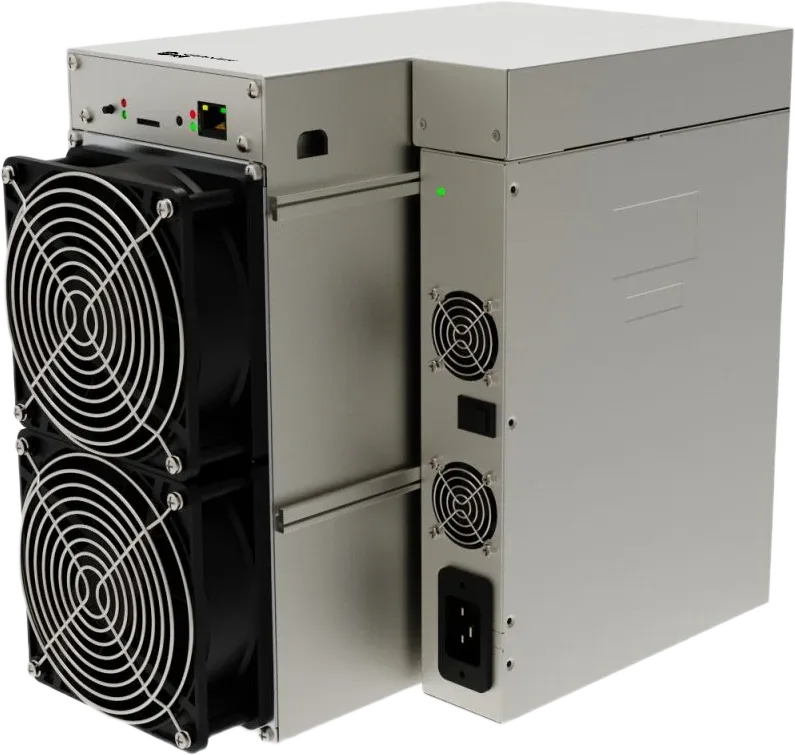
IceRiver Models Explained: KS, AE, AL and RX Miners
Short answer: IceRiver names its ASIC miners after the coin each one mines: KS models mine Kaspa (kHeavyHash), AE models mine Aleo, AL models mine Alephium (Blake3) and RX models mine Radiant (SHA512256d). The digit after the letters rises with size and hashrate, 0 marks IceRiver’s 100 W desktop units, and suffixes such as Lite, Ultra, L and M separate versions of the same line. For example, IceRiver rates the KS0 Ultra at 400 GH/s and 100 W and the KS7 at 30 TH/s and 3,500 W.
This guide explains how to read an IceRiver model name, what each suffix tells you in practice, and IceRiver’s rated hashrate, power and efficiency for every model we list. Bitminers does not guarantee mining profitability.
On this page
Who makes IceRiver miners
IceRiver is the mining-hardware brand of BGIN Blockchain Limited, whose Class A ordinary shares began trading on the Nasdaq Global Market under the ticker BGIN on October 21, 2025. Unlike Bitmain or MicroBT, IceRiver does not build Bitcoin (SHA-256) miners. Its whole lineup targets alternative proof-of-work networks, and its own site sorts the products by coin and algorithm. All of our IceRiver machines are grouped on the IceRiver brand page.
The four IceRiver model lines
The two letters at the start of the name tell you the coin. IceRiver’s site groups them as KAS, ALEO, ALPH and RXD series:
| Prefix | IceRiver series | Coin | Algorithm | Hashrate unit |
|---|---|---|---|---|
| KS | KAS | Kaspa | kHeavyHash | GH/s and TH/s |
| AE | ALEO | Aleo | zkSNARK proving | MH/s and GH/s |
| AL | ALPH | Alephium | Blake3 | GH/s and TH/s |
| RX | RXD | Radiant | SHA512256d | GH/s |
Because each line runs a different algorithm, a miner from one line cannot mine the coin of another, and hashrate figures are only comparable inside the same line. A KS unit rated in TH/s and an AE unit rated in MH/s are measuring different work. Our guide to hashrate, terahash and J/TH explains the units and why efficiency is the fairer comparison.
What the numbers mean
IceRiver does not publish a formal naming key, but its ratings show a consistent pattern:
- 0 is the 100 W desktop class. The KS0 Ultra, AE0, AL0 and RX0 are all rated at about 100 W and can run from a 100-240 V supply.
- Higher numbers are larger machines. In the Kaspa line, IceRiver rates the KS2 Lite at 2 TH/s, the KS3M at 6 TH/s, the KS5L at 12 TH/s, the KS5M at 15 TH/s and the KS7 at 30 TH/s. In the Aleo line, the AE0, AE1 Lite, AE2 and AE3 step from 60 MH/s to 2 GH/s.
- Higher numbers are usually newer. The KS3M dates from October 2023, the KS5L and KS5M from spring 2024 and the KS7 from April 2025; the Aleo line ran from the AE0 in March 2025 to the AE3 in November 2025.
Lite, Ultra, L and M: what the suffixes tell you
The suffixes separate versions within one model number. Read them from the ratings rather than the letters:
- Lite: every Lite model we list (KS2 Lite, KS7 Lite, AE1 Lite and AL2 Lite) is rated at about 500 W. Lite is IceRiver’s mid-size class, between the 100 W desktop units and the 3.4-3.5 kW full-size machines. The KS7 Lite, for example, is rated at 4.2 TH/s against 30 TH/s for the full KS7.
- Ultra and Pro on the KS0: IceRiver’s site lists both a KS0 Pro and a KS0 Ultra. We list the KS0 Ultra, rated at 400 GH/s and 100 W.
- L and M on the KS5: both draw a rated 3,400 W, but IceRiver rates the KS5M at 15 TH/s and the KS5L at 12 TH/s, so the M is the more efficient of the pair. The KS3M is the M version of the KS3 generation.
Treat suffixes as labels, not specifications. Always check the rated hashrate and power of the exact unit, because a Lite in one line is not comparable to a Lite in another.
IceRiver’s ratings for each model we list
Hashrate and power are IceRiver’s rated figures from its product pages, with a stated tolerance of ±5% or ±10% on hashrate and ±10% on power. Efficiency is power divided by hashrate. Listed noise is from IceRiver or, where IceRiver gives none, independent spec databases. Prices are Bitminers prices at the time of writing (October 4, 2026).
| Model | Algorithm | Rated hashrate | Power | Efficiency | Listed noise | Bitminers price |
|---|---|---|---|---|---|---|
| KS0 Ultra | kHeavyHash | 400 GH/s | 100 W | 0.25 J/GH | 35 dB | $112.00 |
| KS2 Lite | kHeavyHash | 2 TH/s | 500 W | 0.25 J/GH | 45 dB | $459.00 |
| KS7 Lite | kHeavyHash | 4.2 TH/s | 500 W | 0.119 J/GH | 50 dB | $699.00 |
| KS3M | kHeavyHash | 6 TH/s | 3,400 W | 0.567 J/GH | 75 dB | $629.00 |
| KS5L | kHeavyHash | 12 TH/s | 3,400 W | 0.283 J/GH | 75 dB | $716.07 |
| KS5M | kHeavyHash | 15 TH/s | 3,400 W | 0.227 J/GH | 75 dB | $700.00 |
| KS7 | kHeavyHash | 30 TH/s | 3,500 W | 0.117 J/GH | 75 dB | $1,829.00 |
| AE0 | Aleo (zkSNARK) | 60 MH/s | 100 W | 1.67 J/MH | 50 dB | $154.00 |
| AE1 Lite | Aleo (zkSNARK) | 300 MH/s | 500 W | 1.67 J/MH | 45 dB | from $979.00 |
| AE2 | Aleo (zkSNARK) | 720 MH/s | 1,300 W | 1.81 J/MH | 50 dB | $2,599.00 |
| AE3 | Aleo (zkSNARK) | 2 GH/s | 3,400 W | 1.7 J/MH | 75 dB | $5,699.00 |
| AL0 | Blake3 | 400 GH/s | 100 W | 0.25 J/GH | 50 dB | $179.00 |
| AL2 Lite | Blake3 | 2 TH/s | 500 W | 0.25 J/GH | not published | $750.00 |
| AL3 | Blake3 | 15 TH/s | 3,500 W | 0.233 J/GH | 75 dB | $2,176.50 |
| RX0 | SHA512256d | 260 GH/s | 100 W | 0.385 J/GH | not published | not listed |
We list the AE1 Lite at 250, 270 and 300 MH/s. IceRiver’s headline rating is 300 MH/s; the 250 MH/s version appears in independent spec databases, and the 270 MH/s figure has no spec-database entry, so confirm the exact unit before ordering.
IceRiver listings on Bitminers
A selection of the models people ask about most, at the time of writing (October 4, 2026):
- IceRiver KS0 Ultra, 400 GH/s (Kaspa, 100 W): $112.00
- IceRiver KS5L, 12 TH/s (Kaspa, 3,400 W): $716.07
- IceRiver KS7, 30 TH/s (Kaspa, 3,500 W): $1,829.00
- IceRiver Aleo AE3, 2 GH/s (Aleo, 3,400 W): $5,699.00
- IceRiver AL3, 15 TH/s (Alephium, 3,500 W): $2,176.50
The full ranges are on our Kaspa miners, Aleo miners and Alephium miners pages.
Matching the model to your space
IceRiver’s lineup falls into three power classes, and the class decides the setup more than the coin does:
- 100 W desktop units (KS0 Ultra, AE0, AL0, RX0): run on 100-240 V AC through an external power supply (19-20 V DC at the miner). IceRiver sells these units without the supply and offers a 120 W unit separately, so check whether a listing includes one.
- 500 W Lite units (KS2 Lite, KS7 Lite, AE1 Lite, AL2 Lite): listed at 45-50 dB where a figure is published; nearly all of the 500 W ends up as heat, so plan for ventilation.
- Full-size units (KS3M, KS5L, KS5M, KS7, AE3, AL3): 3.4-3.5 kW each. IceRiver specifies 200-250 V for the KS7, AL3 and AE3, and they are listed at 75 dB, so most buyers place them in a garage, outbuilding or dedicated mining room.
Before you buy, confirm that a pool supports the coin; our guide on how to mine Kaspa walks through wallets and pools for the KS line. Use current network and electricity data rather than fixed estimates when you compare units. Bitminers does not guarantee mining profitability. For unfamiliar terms, see the mining glossary, and IceRiver’s own KS7 product page for the full spec sheet.
Frequently asked questions
What does Lite mean on an IceRiver miner?
Every Lite model we list (KS2 Lite, KS7 Lite, AE1 Lite and AL2 Lite) is rated at about 500 W, between IceRiver’s 100 W desktop units and its 3.4-3.5 kW full-size machines. IceRiver does not publish a formal definition, so check the rated hashrate of the exact model.
What is the difference between the IceRiver KS5L and KS5M?
Both are rated at 3,400 W, but IceRiver rates the KS5L at 12 TH/s and the KS5M at 15 TH/s, so the KS5M does more work for the same power.
Is the IceRiver KS7 the same as the Antminer KS7?
No. The IceRiver KS7 (30 TH/s, 3,500 W) is made by IceRiver; the Antminer KS7 is a separate Kaspa miner made by Bitmain, which we list at 40 and 45 TH/s. Both mine kHeavyHash.
What does the IceRiver AE3 mine?
The AE3 mines Aleo. IceRiver rates it at 2 GH/s and 3,400 W on 200-250 V, which makes it the largest model in its Aleo line.
Does IceRiver make Bitcoin miners?
No. IceRiver’s lineup covers Kaspa, Aleo, Alephium and Radiant. For Bitcoin you need a SHA-256 miner from makers such as Bitmain, MicroBT or Canaan.