
Bitcoin Mining Glossary: 67 ASIC and Crypto Mining Terms Explained
Short answer: this glossary defines 67 terms you will meet when buying, setting up and running an ASIC miner, from ASIC to worker. It covers the Bitcoin protocol (blocks, nonces, targets, difficulty and halvings), the hashing algorithms used by other coins, miner hardware and cooling, electrical power, and how mining pools measure and pay for work. Definitions follow the Bitcoin developer documentation and each project’s own specifications, and terms link to a longer guide where one exists. Bitminers does not guarantee mining profitability.
Jump to: A | B | C | D | E | F | G | H | I | K | L | M | N | O | P | R | S | T | U | W
A
Air cooling
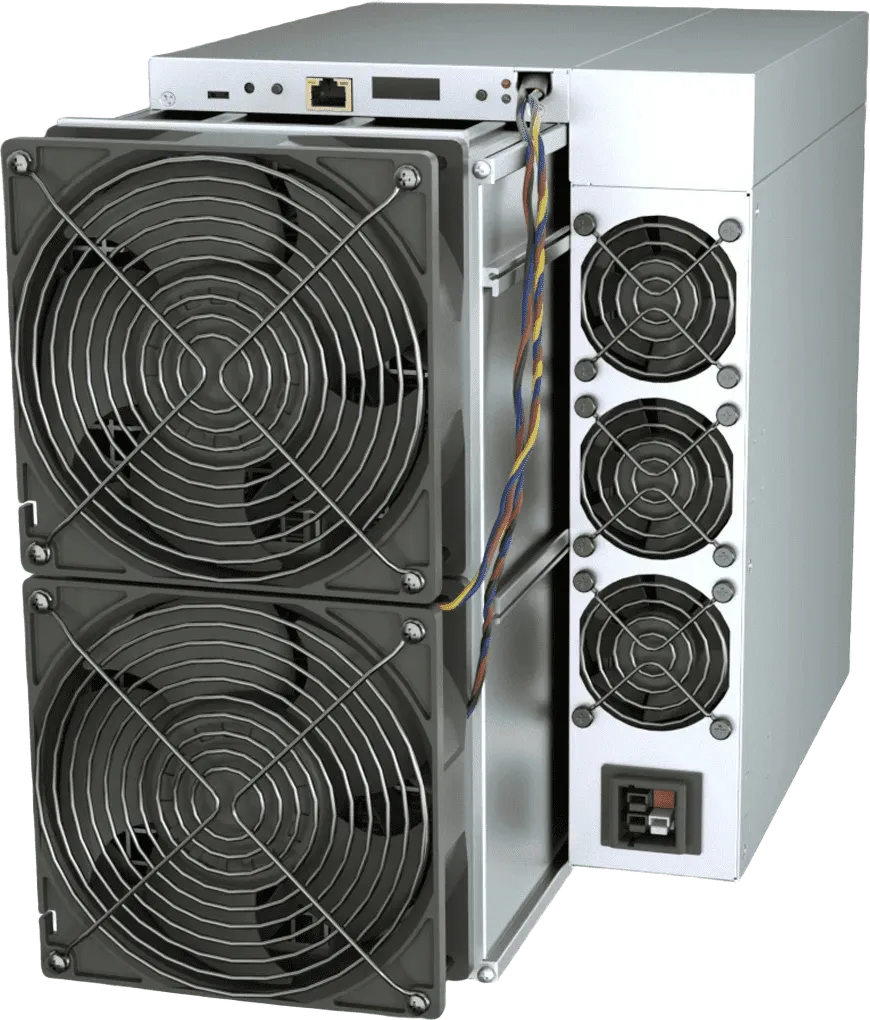
Air cooling removes heat from the hashboards with fans that push air through metal heatsinks and out the back of the machine. It is the most common design for full-size miners and needs no liquid loop, but it depends on plenty of intake air, an exhaust path and dust control, and the fans are loud. Compare it with liquid designs in air cooling vs hydro cooling for Bitcoin mining.
Algorithm
In mining, the algorithm is the proof-of-work hash function a coin’s protocol requires, such as SHA-256 for Bitcoin or Scrypt for Litecoin. Every ASIC is built for exactly one algorithm, so the algorithm decides which coins a machine can mine. Hashrate figures are only comparable between machines that run the same algorithm.
ASIC (application-specific integrated circuit)
An ASIC is a chip designed to do a single job. In mining, the word also means a complete machine built around such chips, for example a Bitcoin miner that computes only SHA-256. An ASIC is far faster and more efficient at its one algorithm than a CPU or graphics card, but cannot mine coins that use another algorithm. See what an ASIC miner is.
B
Blake3
Blake3 is a cryptographic hash function used as the proof-of-work algorithm of Alephium (ALPH). According to Alephium’s mining documentation, a block hash is Blake3 applied twice to the serialized block header. Alephium splits its network into several chains that run in parallel. Blake3 machines are rated in GH/s or TH/s and cannot mine Bitcoin or Kaspa. Browse Alephium (Blake3) miners.
Block
A block is a batch of transactions plus a header that links it to the block before it, which is what forms the blockchain. Miners compete to produce the next valid block; on Bitcoin the protocol aims for one block about every ten minutes on average. Whoever produces the accepted block collects the block reward. See how Bitcoin mining works for the full cycle.
Block header
The block header is the short summary of a block that miners actually hash. On Bitcoin it is 80 bytes with six fields: version, previous block hash, merkle root, timestamp, nBits (the encoded target) and nonce, as listed in the Bitcoin developer reference. Mining means hashing this header repeatedly, changing the nonce and other fields, until the result falls below the target. See What is a nonce in Bitcoin mining?.
Block reward
The block reward is the total amount the creator of a block may claim: the block subsidy plus all transaction fees paid by the transactions in that block. It is paid out through the coinbase transaction. When a pool finds a block, the reward goes to the pool, which pays its members according to its payout scheme.
Block subsidy
The block subsidy is the newly created coin portion of the block reward. On Bitcoin it started at 50 BTC per block and halves every 210,000 blocks. Since block 840,000 in April 2024 it has been 3.125 BTC per block, and it falls to 1.5625 BTC at block 1,050,000. This fixed schedule keeps the total supply of bitcoin just under 21 million coins.
C
Coinbase maturity
Coinbase maturity is the network rule that coins created by a coinbase transaction cannot be spent until 100 further blocks have been added on top of the block containing it; Bitcoin Core defines it as COINBASE_MATURITY = 100. The rule exists because a block can still become stale, and coins from a stale block would disappear.
Coinbase transaction
The coinbase transaction is the first transaction in every block, created by whoever mined it. It has no ordinary inputs; instead it creates the block subsidy and collects the block’s transaction fees, paying them to addresses the miner or pool chooses. Its input field also carries the block height and the extranonce. It is unrelated to the exchange of the same name. See What is a nonce in Bitcoin mining?.
Control board
The control board is the small computer inside an ASIC miner. It runs the firmware, connects to your network over Ethernet, hosts the web interface where you enter pool settings, sends work to the hashboards and reads the temperature and fan sensors. A failed control board stops the whole machine even if the hashboards are healthy.
D
Difficulty
Difficulty is a number that expresses how hard it is to find a valid block compared with the easiest possible block. It is calculated as the difficulty-1 target divided by the current target, so a higher difficulty means a smaller target and more hashes needed per block on average. It follows network hashrate; the Bitcoin Wiki difficulty page shows the formula.
Difficulty adjustment
The difficulty adjustment, or retarget, is the protocol rule that recalculates difficulty so blocks keep arriving at the intended pace. Bitcoin retargets every 2,016 blocks, about two weeks at ten minutes per block, by comparing their actual time with two weeks. Bitcoin Core limits each step to a factor of four in either direction. Many other coins adjust far more often.
Dry cooler
A dry cooler is an outdoor radiator unit with large fans that cools the liquid coming back from hydro-cooled miners or an immersion system by blowing outside air across its coils. It does not evaporate water, which is where the name comes from. Its capacity must match the miners’ total heat load in kilowatts.
E
Efficiency (J/TH)
Efficiency describes how much energy a miner uses for a given amount of work, quoted in joules per terahash (J/TH) for SHA-256 machines. Divide power in watts by hashrate in TH/s: the Antminer S21 XP (270 TH/s) is listed at 3,645 W, which works out to 13.5 J/TH. Lower is better. More on units in hashrate, terahash and J/TH explained.
Equihash
Equihash is a memory-hard proof-of-work algorithm based on the generalized birthday problem. Zcash uses it with the parameters n=200 and k=9. Equihash miners are rated in solutions per second (Sol/s) rather than hashes per second, so their figures cannot be compared with SHA-256 ratings. The Antminer Z15 series is an Equihash example.
Etchash
Etchash is the proof-of-work algorithm of Ethereum Classic (ETC). It is a modified version of Ethash introduced by ECIP-1099, which doubled the DAG epoch length from 30,000 to 60,000 blocks at block 11,700,000, slowing the growth of the large dataset that miners must hold in memory. Etchash ASICs are rated in MH/s or GH/s. Browse Ethereum Classic (Etchash) miners.
Exahash (EH/s)
An exahash per second (EH/s) is one quintillion hashes per second, equal to 1,000 PH/s or 1,000,000 TH/s. It is the unit used for total Bitcoin network hashrate and for the hashrate of large pools. No single machine comes close: reaching just 1 EH/s takes about 4,000 miners rated at 250 TH/s each. Live network figures are published by blockchain explorers.
Extranonce
The extranonce is extra space in the coinbase transaction that miners change once the 32-bit header nonce has been used up. Changing it alters the coinbase transaction, which changes the merkle root and produces a fresh header to hash. In the Stratum protocol the pool assigns each connection an extranonce1 and the miner varies extranonce2, so miners do not repeat each other’s work.
F
Firmware
Firmware is the operating software that runs on a miner’s control board. It sets chip frequencies and voltages, controls fans or pumps, reports hashrate and temperatures, and stores your pool settings. Manufacturers ship their own stock firmware, while third-party firmware offers extra tuning options but can affect warranty coverage. See ASIC miner firmware explained.
FPPS (full pay per share)
FPPS is a pool payout scheme that pays a fixed expected value for every accepted share, covering both the block subsidy and transaction fees (or an estimate of them). The pool, not the miner, absorbs the luck of finding or not finding blocks, and it charges a fee for carrying that risk. Payments do not depend on the pool’s daily luck. See FPPS vs PPS vs PPLNS.
G
Gigahash (GH/s)
A gigahash per second (GH/s) is one billion hashes per second, and 1,000 GH/s equals 1 TH/s. GH/s is common for Scrypt machines that mine Litecoin and Dogecoin, for Etchash machines, and for smaller Kaspa and Alephium units. Compare GH/s figures only between machines on the same algorithm.
H
Halving
A halving is the scheduled 50% cut in the block subsidy. Bitcoin halves every 210,000 blocks, roughly every four years: from 50 BTC to 25, 12.5, 6.25 and then, at block 840,000 in April 2024, to 3.125 BTC. The next halving is due at block 1,050,000. Transaction fees are not affected by a halving.
Hash
A hash is the fixed-length output of a hash function. Any change to the input, even a single bit, produces a completely different and unpredictable output. Mining is the repeated hashing of a block header (on Bitcoin, SHA-256 applied twice) in search of an output that is numerically below the target. Hashrate counts these attempts per second.
Hashboard
A hashboard is the circuit board that carries a miner’s ASIC chips, plus power regulation and temperature sensors. Most full-size air-cooled miners have three hashboards in the case, each connected to the control board and the power supply. If one board fails, the machine usually keeps running on the others at reduced hashrate. Details in ASIC chips and hashboards.
Hashprice
Hashprice is the expected value of one unit of hashrate per day, usually quoted in US dollars or bitcoin per PH/s (or TH/s) per day. It combines coin price, block subsidy, transaction fees and network difficulty into a single figure that changes daily. It is a market indicator, not a forecast for any particular machine or site. See hashprice explained.
Hashrate
Hashrate is the number of hashes a miner, pool or network performs per second. A machine’s rated hashrate is the manufacturer’s nominal figure; the hashrate a pool reports for your worker is estimated from accepted shares and moves up and down from hour to hour. Network hashrate is also an estimate derived from block times and difficulty.
Heat exchanger
A heat exchanger moves heat from one fluid to another without mixing them, for example from an immersion tank’s dielectric fluid to a water loop, or from a hydro miner’s coolant to a building’s water system. The heat is finally released outdoors through a dry cooler or cooling tower, or reused for space or water heating.
Home miner
A home miner is a small ASIC designed for a residential setting. It typically plugs into a standard 120 V US outlet, draws far less power than a full-size machine and delivers a small fraction of its hashrate. Many owners use them for solo mining, for learning, or as a source of room heat. Bitminers groups these machines under home miners.
Hydro cooling
Hydro cooling (water cooling) circulates liquid coolant through cold plates attached to the hashboards instead of relying on fans. Hydro miners, often labeled Hyd, need pumps, piping, a heat exchanger or dry cooler and usually three-phase power; Bitmain specifies 380-415 V for its Hyd models. They pack more hashrate into each unit than air-cooled designs. Browse hydro-cooled miners.
I
Immersion cooling
Immersion cooling submerges miners in a tank of electrically non-conductive (dielectric) fluid that absorbs heat directly from the chips and carries it to a heat exchanger. Fans are removed, and the fluid keeps dust and humidity away from the boards. Some models are built for immersion; some air-cooled ones can be adapted. See immersion cooling for Bitcoin mining.
Immersion fluid
Immersion fluid is the dielectric liquid used in immersion cooling. Single-phase systems use fluids that stay liquid, such as synthetic hydrocarbons or mineral oils, and pump them through a heat exchanger. Two-phase systems use engineered fluids that boil on the chips and condense on a coil. Follow the manufacturer’s guidance on fluid compatibility. Browse immersion miners.
Input voltage
Input voltage is the supply voltage a miner’s power supply accepts, printed on its specification sheet. Bitmain rates its air-cooled S21 models for 220-277 V single-phase input, so they cannot run from a standard 120 V US household outlet; a dedicated 240 V circuit installed by a licensed electrician is the usual solution. Check voltage, amperage and plug type before you order.
K
kHeavyHash
kHeavyHash is the proof-of-work algorithm of Kaspa (KAS). It places a matrix multiplication step between two Keccak-family hashing steps. Kaspa is a blockDAG whose blocks are ordered by the GHOSTDAG protocol, and since its Crescendo upgrade in May 2025 it targets ten blocks per second. kHeavyHash ASICs cannot mine Bitcoin. See how to mine Kaspa.
Kilowatt-hour (kWh)
A kilowatt-hour is the unit of energy on an electricity bill: 1,000 watts drawn for one hour. A miner’s daily consumption is its power in kilowatts multiplied by 24, so a 3,500 W machine running around the clock uses 84 kWh per day. Your utility’s rate per kWh, plus any demand charges in a commercial tariff, sets the cost of that energy.
L
Lottery miner
A lottery miner is a small, low-power device pointed at a solo mining pool. Its chance of finding a Bitcoin block on any given day is extremely small, but if it does, it receives the whole block reward rather than a pool share. Bitaxe and NerdQaxe units are common examples. It is a hobby with very long odds; see solo Bitcoin mining and lottery miners.
M
Megahash (MH/s)
A megahash per second (MH/s) is one million hashes per second, and 1,000 MH/s equals 1 GH/s. It appears mostly in ratings for memory-heavy algorithms, such as Etchash, and for some Scrypt machines. On a modern Bitcoin ASIC it is far too small a unit to be useful, since those machines are rated in hundreds of TH/s.
Mempool
The mempool (memory pool) is the set of valid, unconfirmed transactions a node is holding while they wait to be included in a block. Each node keeps its own. Pools usually build block templates by choosing the transactions that pay the highest fee per unit of block space, so a crowded mempool tends to push fees up.
Merged mining
Merged mining lets one proof of work secure two chains that share an algorithm. The auxiliary chain accepts work from a parent chain by checking a merkle branch placed in the parent block’s coinbase transaction, a scheme called auxiliary proof of work (AuxPoW). Namecoin with Bitcoin, and Dogecoin with Litecoin since 2014, are long-running examples. See merged mining Litecoin and Dogecoin.
Merkle root
The merkle root is a single 32-byte hash in the block header that commits to every transaction in the block. Transactions are hashed in pairs, layer by layer, until only one hash remains. Changing any transaction, including the extranonce inside the coinbase transaction, changes the merkle root, which is how miners obtain new headers to hash once the nonce runs out.
Mining pool
A mining pool combines the hashrate of many miners, finds blocks as a group and splits the value among members according to the shares each one submits, minus a fee. Pools turn the rare, all-or-nothing outcome of solo mining into smaller, regular payouts. They differ in payout scheme, fee, minimum payout and server locations. See mining pools explained.
N
Node
A node is a computer running a coin’s full software, such as Bitcoin Core, that downloads, validates and relays blocks and transactions. Every pool runs nodes to build its block templates. An ASIC owner does not need a personal node to mine through a pool, but solo miners, and pool members using Stratum V2 to choose their own transactions, may run one.
Nonce
The nonce is a 32-bit field in the Bitcoin block header that miners change on each hashing attempt, giving about 4.29 billion possible values. A modern ASIC works through all of them in well under a millisecond, so miners also change the timestamp, roll permitted version bits and update the extranonce to keep producing fresh headers to hash. See What is a nonce in Bitcoin mining?.
O
Orphan block (stale block)
Strictly, an orphan block is one whose parent a node has not received yet. In everyday mining talk the word usually means a stale block: a valid block that lost a race because another block at the same height was built on first. A stale block’s reward does not count on the main chain.
Overclocking
Overclocking runs a miner’s chips at a higher frequency than the stock setting to raise hashrate. Power draw and heat rise faster than hashrate, so efficiency in J/TH usually gets worse, and the extra load stresses chips, power supply and cooling. It is normally done through firmware settings and may affect warranty terms, so check the manufacturer’s policy first.
P
Petahash (PH/s)
A petahash per second (PH/s) is one quadrillion hashes per second, equal to 1,000 TH/s. It is a common unit for describing a mining farm, a pool account or hashprice. Four machines rated at 250 TH/s each add up to 1 PH/s, and 1,000 PH/s make one exahash per second.
Pool fee
The pool fee is the percentage a mining pool deducts from members’ payouts to cover its operations and, on PPS-style schemes, the risk of paying for shares when no block is found. Compare a fee together with its payout method, because a fee on a PPLNS pool is not directly comparable with a fee on an FPPS pool.
Power supply unit (PSU)
The power supply unit converts AC power from the wall or a power distribution unit into the low-voltage DC that the hashboards and control board use. Most full-size miners use a PSU matched to the model. The PSU’s rating, input voltage and plug type decide what electrical circuit the miner needs.
PPLNS (pay per last N shares)
PPLNS is a pool payout scheme that pays members only when the pool actually finds a block, dividing that block’s reward among the last N shares submitted before it. Payouts follow the pool’s real luck, so they fluctuate more than under PPS or FPPS, and a miner who joins or leaves part way through receives credit only for shares inside the window. See FPPS vs PPS vs PPLNS.
PPS (pay per share)
PPS is a pool payout scheme that pays a fixed amount for every accepted share, in proportion to the share’s difficulty and based on the block subsidy, whether or not the pool finds a block. The pool carries the variance. Classic PPS leaves transaction fees out of the per-share amount, which is the main difference from FPPS. See FPPS vs PPS vs PPLNS.
Proof of work
Proof of work is the consensus method in which a valid block must carry a hash below a target, which on average takes a predictable amount of brute-force computation. It makes rewriting history expensive, because an attacker would have to redo the work. Bitcoin, Litecoin, Kaspa and Zcash use it; see proof of work vs proof of stake.
R
RandomX
RandomX is the proof-of-work algorithm Monero has used since November 30, 2019. It runs randomly generated programs in a virtual machine and needs about 2 GB of memory in its mining mode, a design that favors general-purpose CPUs. It was built to resist ASICs, so Monero is still mined mostly on ordinary computers.
S
Scrypt
Scrypt is a memory-hard hash function used as the proof-of-work algorithm of Litecoin and Dogecoin. Because Dogecoin accepts merged-mined work from Litecoin, one Scrypt ASIC can mine both coins at once. Scrypt miners are rated in MH/s or GH/s, and Scrypt ASICs cannot mine Bitcoin. Browse Scrypt miners for Litecoin and Dogecoin.
SHA-256
SHA-256 is the hash function Bitcoin uses for proof of work, applied twice to the 80-byte block header (often written SHA-256d). Bitcoin Cash and a few other chains use it as well. SHA-256 ASICs are rated in TH/s and are the machines most people mean when they say Bitcoin miners. Browse SHA-256 Bitcoin miners.
Share
A share is a hash that meets the pool’s own target, which is set far easier than the network target. Shares prove to the pool how much work a miner has done; most are not blocks, but occasionally a share also meets the network target and becomes a valid block. Pools count accepted shares, weighted by difficulty, to calculate payouts.
Solo mining
Solo mining means trying to find blocks on your own, either with your own node or through a solo pool service, and collecting the full block reward if you succeed. With no sharing, the outcome depends entirely on luck, and a small miner can run for years without finding a block. Most owners of full-size machines use a pool instead.
Stale share
A stale share is one submitted for a job the pool has already replaced, usually because a new block appeared on the network while the share was on its way. Pools reject stale shares, and they count for nothing. A small percentage is normal; a high rate points to network latency or a distant pool server.
Stratum
Stratum is the protocol miners use to talk to pools: a JSON-RPC connection over TCP, entered in the miner as a URL such as stratum+tcp://host:port. The pool sends jobs and sets share difficulty; the miner subscribes, authorizes its worker name and submits shares. Stratum V2 is a newer protocol that encrypts the connection and can let miners choose their own block transactions.
T
Target
The target is a 256-bit number that a block header’s hash must be below for the block to be valid. It is stored in the header in compact form as the nBits field. A lower target means fewer valid hashes and more work per block on average. Pools use the same idea with a much higher, easier share target.
Terahash (TH/s)
A terahash per second (TH/s) is one trillion hashes per second, equal to 1,000 GH/s. TH/s is the standard rating unit for current SHA-256 Bitcoin miners; models in the Antminer S21 series and the Whatsminer lineup are rated in the hundreds of TH/s. Large Kaspa and Alephium machines are also rated in TH/s, but those figures are not comparable with SHA-256 ones.
Three-phase power
Three-phase power delivers electricity over three alternating conductors and is standard in commercial and industrial buildings. Large hydro and immersion miners often require it; Bitmain specifies 380-415 V three-phase for its Hyd models. US commercial three-phase service is commonly 208 V or 480 V, so voltage matching and an electrician’s assessment should come before ordering such a miner.
Transaction fee
A transaction fee is the difference between the value of a transaction’s inputs and its outputs. The miner that includes the transaction in a block collects it as part of the block reward. Users set fees while competing for limited block space, so fees rise and fall with demand. Unlike the block subsidy, fees are not cut at a halving.
U
Underclocking
Underclocking lowers chip frequency, and usually voltage, below the stock settings. Hashrate falls, but power falls faster, so efficiency in J/TH often improves. Owners use it to fit a machine onto a limited circuit, cut heat output in summer or reduce fan speed. Some stock firmware offers low-power modes, and third-party firmware offers finer control.
Uptime
Uptime is the share of time a miner is hashing and connected to its pool, usually shown as a percentage. Power outages, overheating, network faults, firmware crashes and pool disconnects all reduce it. Because a miner contributes nothing while it is offline, uptime matters as much as rated hashrate when you read pool statistics.
W
Wallet address
A wallet address is where pool payouts or solo block rewards are sent. Pools pay to it once your balance passes a minimum. Use an address you control, and make sure it belongs to the right coin and network: a Litecoin address cannot receive bitcoin, and funds sent to the wrong network may be lost.
Watt (W)
A watt is a unit of power, the rate at which a device uses energy. Miner specification sheets list power in watts at the rated hashrate, for example 3,645 W for the Antminer S21 XP at 270 TH/s. Watts divided by TH/s gives J/TH efficiency, and watts multiplied by hours of running time gives watt-hours of energy.
Worker
A worker is the name a pool uses to identify one miner, or a group of miners, on your account, usually entered as accountname.workername in the miner’s pool settings. Separate worker names let you see each machine’s hashrate and stale-share rate on the pool dashboard and quickly spot a machine that has dropped offline.
Frequently asked questions
What is the difference between hashrate and difficulty?
Hashrate measures speed: how many hashes a miner or the whole network performs per second. Difficulty measures how hard each block is to find. They are linked through the difficulty adjustment: when total network hashrate rises, blocks arrive faster, and at the next retarget Bitcoin raises difficulty so blocks return to about one every ten minutes.
What is the difference between a share and a block?
Both are hashes below a target, but against different targets. A share only needs to beat the pool’s easy target and proves your machine is working. A block must beat the network target, which is far harder. Every block a pool member finds is also a share, but almost no shares are blocks.
Why can a Bitcoin miner not mine Kaspa or Litecoin?
Each ASIC is hard-wired for one algorithm. Bitcoin uses SHA-256, Kaspa uses kHeavyHash and Litecoin uses Scrypt, so a SHA-256 machine cannot compute the other two at all. Coins that share an algorithm, such as Litecoin and Dogecoin, can be mined by the same machine.
Which terms matter most when comparing two ASIC miners?
Start with the algorithm, then compare hashrate, power in watts and efficiency in J/TH for machines on the same algorithm. Then check cooling type (air, hydro or immersion), input voltage and whether you need three-phase power, because those decide whether the machine suits your site. Bitminers does not guarantee mining profitability.