
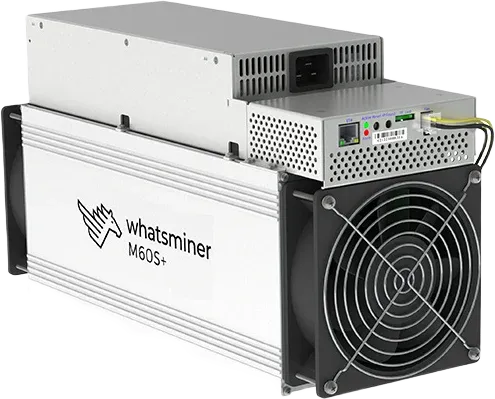
Whatsminer Models Explained: How MicroBT Model Numbers Work
Short answer: Whatsminer is MicroBT’s line of SHA-256 Bitcoin miners, and its model numbers follow a readable pattern. The tens digit after the M is the generation (M30, M50, M60, M70), the last digit indicates cooling across MicroBT’s current lineup (0-2 air, 3 and 9 hydro, 6 and 8 immersion), and the S, + and ++ suffixes mark progressively more efficient versions. For example, MicroBT rates the hydro-cooled M63 at 19.9 J/TH and the M63S++ at 15.5 J/TH.
This guide decodes the numbering, lists MicroBT’s rated hashrate, power and efficiency for each current Whatsminer model, and shows which cooling setup each one needs. Bitminers does not guarantee mining profitability.
On this page
How to read a Whatsminer model number
Take the M63S++ as an example and read it in four parts:
- M: every Whatsminer model starts with it.
- 6: the generation, here the M60 series.
- 3: the form factor and cooling, here hydro.
- S++: the efficiency tier within that model, here the highest of the M63 family.
Store listings add the hashrate bin after the name, as in “M63S++, 478 TH/s”. Every Whatsminer model in this guide mines SHA-256, so it works on Bitcoin (and Bitcoin Cash or Bitcoin SV).
The last digit: air, hydro or immersion
Across MicroBT’s current lineup, the last digit of the series number lines up with the cooling method:
| Last digit | Cooling | Examples | Power supply |
|---|---|---|---|
| 0, 1, 2 | Air (fans) | M30S+, M50, M60S, M60S++, M61S+, M70S, M72 | 220-240 V single-phase on MicroBT’s air PSUs |
| 3, 9 | Hydro (liquid loop) | M63 family, M73S+, M79S | 380-480 V three-phase |
| 6, 8 | Immersion (tank) | M66 family, M76, M78 | 380-480 V three-phase |
How far this is verified: MicroBT’s own product pages confirm air cooling for the M30S+, the M50 series, the M60S, the M60S++ and the M70S, hydro cooling for the whole M63 family, and immersion cooling for the whole M66 family. The M61S+, M72, M73S+, M76, M78 and M79S assignments come from MicroBT’s launch announcements as reported by industry press. MicroBT does not publish the pattern as a formal naming rule, so treat the digit as a strong hint and confirm the cooling on the spec sheet before you plan a site.
S, + and ++: efficiency tiers
Within one model, each added suffix marks a more efficient version. MicroBT’s ratings show the step clearly:
- M50 family (air): M50 at 28-29 J/TH, M50S at 26 J/TH, M50S+ at 23 J/TH.
- M63 family (hydro): M63 at 19.9 J/TH, M63S at 18-18.5 J/TH, M63S+ at 17 J/TH, M63S++ at 15.5 J/TH.
- M66 family (immersion): M66 at 19.9 J/TH, M66S at 18.5 J/TH, M66S+ at 17 J/TH, M66S++ at 15.5 J/TH.
MicroBT also sells several hashrate bins inside each tier, so two units of the same model can be rated at different TH/s with the same J/TH. Efficiency is the clearer signal: hashrate ranges of neighbouring tiers can overlap, as the M50 (up to 124 TH/s) and M50S (from 124 TH/s) do. Our guide to hashrate, terahash and J/TH explains the units.
Whatsminer generations: M30 to M70
The tens digit tracks the generation, and each one lowered the J/TH:
- M30S series (2020): the M30S+ and M30S++, at 34 and 31 J/TH.
- M50 series (2022): MicroBT announced the M50 and M50S in April 2022; the M50S+ followed in December 2022.
- M60 series (October 2023): launched with the air M60S, hydro M63 and immersion M66 families. MicroBT added the S++ versions and the M61S+ in December 2024.
- M70 series (December 2025): MicroBT launched it at Bitcoin MENA with air (M70, M70S, M72), hydro (M73, M79) and immersion (M76, M78) models. Its M70S product page lists 248 TH/s at 13.5 J/TH and 3,348 W.
MicroBT’s ratings for each model
Figures are MicroBT’s published ratings from its shop pages and launch announcements; where MicroBT gives a range or several bins, the table shows the range. Power is MicroBT’s figure or hashrate multiplied by J/TH.
| Model | Rated hashrate | Power | Efficiency | Cooling | Released |
|---|---|---|---|---|---|
| M30S+ | 100 TH/s | 3,400 W | 34 J/TH | Air | 2020 |
| M30S++ | 102-104 TH/s | 3,162-3,224 W | 31 J/TH | Air | 2020 |
| M50 | 114-124 TH/s | 3,306-3,472 W | 28-29 J/TH | Air | 2022 |
| M50S | 124-126 TH/s | 3,224-3,276 W | 26 J/TH | Air | 2022 |
| M50S+ | 148 TH/s | 3,404 W | 23 J/TH | Air | 2022 |
| M60S | 170-188 TH/s | up to 3,478 W | 18.5 J/TH | Air | 2023 |
| M60S++ | 218-226 TH/s | 3,379-3,503 W | 15.5 J/TH | Air | 2024 |
| M61S+ | 236 TH/s | 4,012 W | 17 J/TH | Air | 2024 |
| M63 | 334-372 TH/s | 6,646-7,403 W | 19.9 J/TH | Hydro | 2023 |
| M63S | 360-408 TH/s | 6,660-7,344 W | 18-18.5 J/TH | Hydro | 2023 |
| M63S+ | 390-450 TH/s | up to 7,650 W* | 17 J/TH* | Hydro | 2024 |
| M63S++ | 464-478 TH/s | 7,192-7,409 W | 15.5 J/TH | Hydro | 2024 |
| M66 | 238-280 TH/s | 5,492 W at 276 TH/s | 19.9 J/TH | Immersion | 2023 |
| M66S | 270-298 TH/s | 4,995-5,513 W | 18.5 J/TH | Immersion | 2023 |
| M66S+ | 318 TH/s* | 5,406 W* | 17 J/TH* | Immersion | 2024 |
| M66S++ | 356 TH/s | 5,518 W | 15.5 J/TH | Immersion | 2024 |
| M70S | 248 TH/s | 3,348 W | 13.5 J/TH | Air | 2025 |
| M73S+ | 540-600 TH/s | 6,750-7,500 W | 12.5 J/TH | Hydro | 2025 |
| M79S | 930-1,040 TH/s | about 14,000 W | 13.5 J/TH | Hydro | 2025 |
*MicroBT’s pages give no rating for the M66S+ or an efficiency for the M63S+; these figures come from independent spec databases. The M60S range combines MicroBT’s launch figures with the bins on its M60S product page. MicroBT quotes the M79S with a ±10% hashrate tolerance and an overclock ceiling of 20,000 W.
Whatsminer listings on Bitminers
All of our MicroBT machines are grouped on the MicroBT brand page. A selection at the time of writing (October 4, 2026):
- Whatsminer M50, 124 TH/s (air): $1,686.65
- Whatsminer M60S++, 226 TH/s (air): $3,740.00
- Whatsminer M63S++, 478 TH/s (hydro): $5,499.00
- Whatsminer M66S++, 356 TH/s (immersion): $5,247.90
- Whatsminer M73S+, 540 TH/s (hydro): $10,199.00
Matching the model to your site
Because the last digit tells you the cooling, it also tells you most of the site requirements:
- Air (0, 1, 2): runs on MicroBT’s 220-240 V power supplies with fans moving air through the case. Plan for ventilation and heat removal from the room.
- Hydro (3, 9): needs a coolant loop and 380-480 V three-phase power. The M63 family draws roughly 6.6-7.7 kW per unit. See air cooling vs hydro cooling and our hydro-cooled miners.
- Immersion (6, 8): runs submerged in a tank of dielectric fluid, also on 380-480 V three-phase power. Our guide to immersion cooling for Bitcoin mining covers tanks and fluid, and the units are listed under immersion miners.
Compare models on J/TH, the power and cooling your site can supply, and purchase price, and use current hashprice and electricity data rather than fixed estimates. Bitminers does not guarantee mining profitability.
Frequently asked questions
What does the last number in a Whatsminer model mean?
Across MicroBT’s current lineup it indicates cooling: 0, 1 and 2 are air-cooled, 3 and 9 hydro-cooled, 6 and 8 immersion-cooled. MicroBT does not publish this as a formal rule, so confirm it on the spec sheet.
What is the difference between the Whatsminer M60S and M60S++?
Both are air-cooled. MicroBT rates the M60S at 170-188 TH/s and 18.5 J/TH (2023) and the M60S++ at 218-226 TH/s and 15.5 J/TH (2024).
What is the difference between the Whatsminer M63S and M66S?
They are the same generation and efficiency tier with different cooling: the M63S is hydro-cooled (360-408 TH/s), the M66S immersion-cooled (270-298 TH/s), both around 18.5 J/TH.
What is the Whatsminer M70?
The M70 series is MicroBT’s December 2025 generation. It spans air, hydro and immersion models; the air-cooled M70S is rated at 248 TH/s and 13.5 J/TH on MicroBT’s shop.
Does the S suffix mean a Whatsminer is used or refurbished?
No. S, + and ++ are MicroBT’s efficiency tiers for new models. For example, the Whatsminer M50S is rated at 26 J/TH against 28-29 J/TH for the M50.