
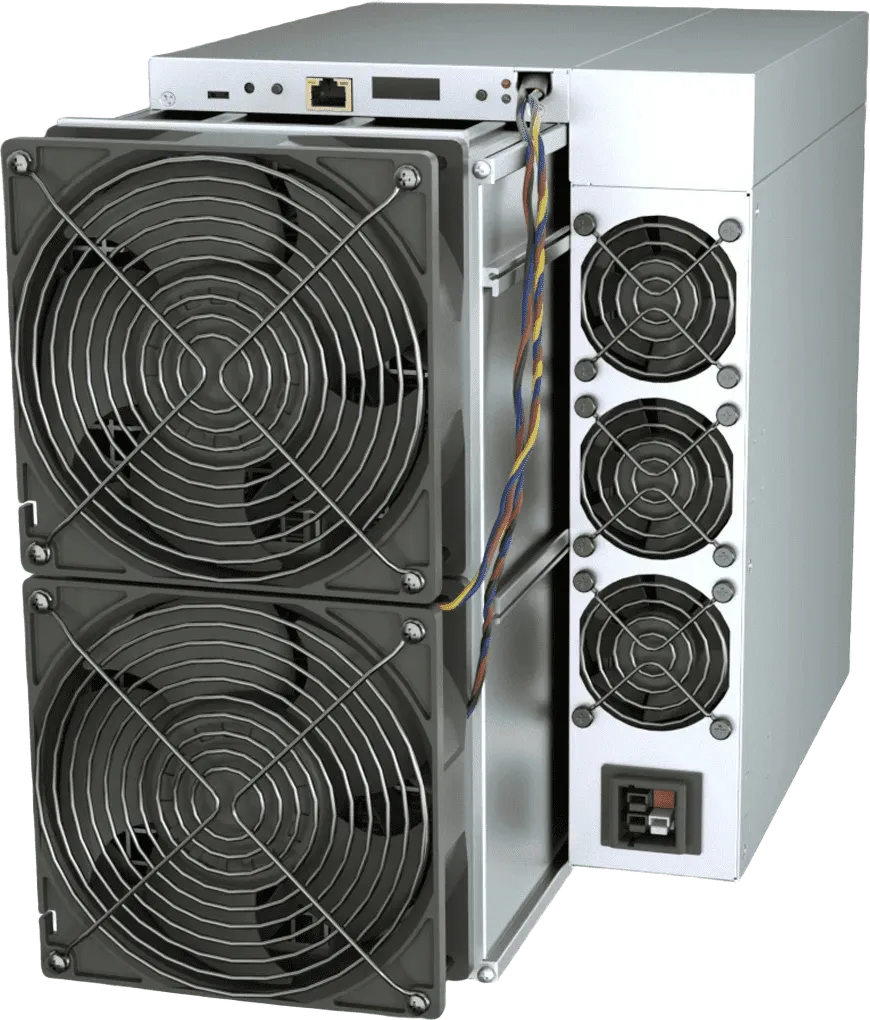
ASIC Chips and Hashboards Explained: What Is Inside a Bitcoin Miner
Short answer: an ASIC chip is a small integrated circuit designed to run one mining algorithm, such as SHA-256 for Bitcoin, and nothing else. A full-size Bitcoin miner groups dozens of these chips onto each of its hashboards, usually three, and adds a control board, a power supply and cooling. The chips do the hashing, so their generation largely decides how efficient the whole machine is, measured in joules per terahash (J/TH).
This guide explains what sits inside a Bitcoin miner, how the parts work together, how chip generations affect efficiency, and what to check on the hashboards when a new machine arrives. For the basics of what an ASIC miner is and how to read its specifications, start with What Is an ASIC Miner?
What is an ASIC chip?
ASIC stands for application-specific integrated circuit. A general-purpose processor can run any program, but it spends silicon and power on flexibility. An ASIC chip for Bitcoin has its circuitry laid out for one task: computing double SHA-256 hashes of block headers as quickly as possible for every watt it draws. That is why an ASIC miner is far more efficient than a CPU or graphics card at its own algorithm, and why it cannot be repurposed for a different one.
Each chip contains many hashing cores working in parallel. On its own, a single modern chip produces a meaningful but small amount of hashrate. You can see this in single-chip open-source miners: the open-source Bitaxe project documents that the Bitaxe Ultra uses Bitmain’s BM1366 chip (also used in the Antminer S19 XP and S19k Pro), the Bitaxe Supra uses the BM1368 from the Antminer S21, and the Bitaxe Gamma uses the BM1370 from the Antminer S21 Pro. A unit such as the Bitaxe Gamma 601 (1.2 TH/s, 17 W) is essentially one chip with its own power regulation, controller and fan.
What is a hashboard?
A hashboard (also written “hash board”) is the circuit board that carries the ASIC chips, the power regulation that feeds them, temperature sensors and a heatsink or cooling plate. In a full-size miner, each hashboard holds dozens of chips connected in a chain, so the control board can send work to the chips and collect results from them. The exact chip count varies by model and generation, so treat the manufacturer’s specifications as the authority for any particular machine.
When people talk about an “Antminer hash board”, they usually mean one of the three boards inside a Bitmain Antminer. Other manufacturers such as MicroBT (Whatsminer) and Canaan (Avalon) use the same general layout, although board design, chip suppliers and connectors differ between brands and between generations of the same brand.
How the parts form a complete miner
| Component | What it does | What goes wrong if it fails |
|---|---|---|
| Hashboards (usually 3) | Run the ASIC chips that perform the hashing | Lower total hashrate, or a board that is not detected at all |
| Control board | Runs the firmware and web dashboard, connects to the pool over Ethernet, and distributes work to the hashboards | The miner cannot connect, configure or report status |
| Power supply (PSU) | Converts mains AC power to the DC voltage the hashboards need | Boards drop out, the miner restarts or does not power on |
| Cooling | Fans on air-cooled units, water plates on hydro units, fluid contact on immersion units | Chips overheat and the firmware throttles or shuts the miner down |
The total hashrate on the label is the sum of the three boards. If one board stops hashing, the machine keeps running on the other two, but at roughly two-thirds of its rated output, which is why checking each board matters (more on that below).
Chip generations and efficiency (J/TH)
Efficiency is power divided by hashrate, and lower is better. Each new chip generation from a manufacturer has generally delivered more hashes per joule, so newer machines do the same work with less electricity. The table below uses specifications from the Bitminers catalog to show how far that has moved across several Antminer generations.
| Model | Hashrate | Power | Efficiency | Cooling |
|---|---|---|---|---|
| Antminer S19 | 95 TH/s | 3,250 W | 34.2 J/TH | Air |
| Antminer S19 XP | 141 TH/s | 3,032 W | 21.5 J/TH | Air |
| Antminer S21 Pro | 245 TH/s | 3,675 W | 15.0 J/TH | Air |
| Antminer S21 XP | 270 TH/s | 3,645 W | 13.5 J/TH | Air |
| Antminer S23 Hyd | 580 TH/s | 5,510 W | 9.5 J/TH | Hydro |
Two points stand out. First, the S21 XP draws about 20% more power than the S19 XP but produces almost twice the hashrate. Second, hydro cooling lets a manufacturer run more chips at higher density, which is how the S23 Hyd reaches both a higher hashrate and a lower J/TH figure. Efficiency also depends on firmware settings: many machines can be tuned for lower power and better J/TH or for higher hashrate at worse J/TH.
Because Bitcoin’s network difficulty rises as more efficient hardware joins, a machine’s chip generation largely decides how long it stays competitive. Our best ASIC miners comparison lists efficiency for current models.
Common hashboard faults
Hashboards are the part of a miner that works hardest, and most faults reported on miners show up on them. Typical symptoms include:
- A board not detected: the dashboard shows only two boards, or one shows zero hashrate. Causes range from a loose data cable or power connector to a failed component on the board.
- Missing chips: the dashboard reports fewer chips on one board than on the others. Because chips are connected in a chain, one faulty chip or its supporting parts can affect the chips after it.
- Low hashrate on one board: one board consistently produces less than the others, often linked to heat, dust or a power-regulation issue.
- Temperature errors: a sensor reading out of range, or chips overheating because of blocked airflow, failed fans or, on hydro units, poor coolant flow.
- Problems that look like board faults but are not: an undersized or failing power supply, an unstable mains voltage or a bad Ethernet connection can all make boards drop out.
Most board-level problems are made worse by heat and dust. Clean intake air, correct coolant flow on hydro units and an electrical circuit sized for continuous load protect the boards more than anything else.
Why buyers check that every board hashes
When a new miner arrives, the most useful first check is the miner’s own dashboard after it has run for a while:
- Confirm that all hashboards are detected.
- Compare the chip count on each board; they should match one another.
- Compare the hashrate of each board; they should be close to one another, and the total should be in line with the rated hashrate once the machine has warmed up.
- Check that board and chip temperatures are within normal limits for your cooling setup.
- Take screenshots of the dashboard for your records.
Doing this early matters because hardware coverage is time-limited. Bitminers sells new machines with a 30-day limited warranty and does not offer a repair service beyond it. Read the warranty policy for what is covered and how to report a problem.
How this relates to buying new hardware
Understanding chips and boards makes the specification sheet easier to read. When comparing Bitcoin (SHA-256) miners:
- Start with efficiency. The J/TH figure mostly reflects the chip generation and the cooling design.
- Match the cooling to your site. Air-cooled models such as the Antminer S21 family need strong airflow; hydro models such as the Antminer S23 Hyd need a liquid loop.
- Check the power requirement. A higher-hashrate machine usually draws more watts even when it is more efficient.
- Use real numbers for cost. Enter the hashrate and power in the ASIC miner profitability calculator with your own electricity price. Bitminers does not guarantee mining profitability.
Frequently asked questions
What is a hash board?
A hash board (also written hashboard or hashing board) is the circuit board inside an ASIC miner that carries the mining chips, their power regulation, temperature sensors and a heatsink or cooling plate. Most full-size Bitcoin miners have three hash boards, which the control board feeds with work from the pool while the power supply feeds them power; the chips on each board do the actual hashing.
How many hashboards does a Bitcoin miner have?
Most full-size Bitcoin miners have three hashboards, a control board and a power supply. Small home miners such as the Bitaxe use a single board, and some designs use one chip in total.
Can a miner run with one hashboard missing?
Usually yes. The remaining boards keep hashing, but total hashrate falls by roughly the share of the missing board. A new machine should show every board hashing, so check the dashboard soon after setup.
Can I replace the ASIC chips with newer ones?
Not in a practical sense. Each hashboard is designed for a specific chip, footprint and power design, so a newer chip generation means a new board design and, in practice, a new machine.
Does a better ASIC chip mean a better miner?
The chip generation is the biggest factor in efficiency, but cooling, firmware tuning and power supply quality also matter. Compare the whole machine’s J/TH, power draw and cooling type rather than the chip alone.