
Hashrate Converter: H/s, kH/s, MH/s, GH/s, TH/s, PH/s and EH/s
Short answer: hashrate units go up in steps of 1,000: 1 kH/s = 1,000 H/s, 1 MH/s = 1,000 kH/s, 1 GH/s = 1,000 MH/s, 1 TH/s = 1,000 GH/s, 1 PH/s = 1,000 TH/s, 1 EH/s = 1,000 PH/s and 1 ZH/s = 1,000 EH/s. To go to a smaller unit, multiply by 1,000 for each step. To go to a larger unit, divide by 1,000 for each step. So 234 TH/s is 234,000 GH/s or 0.234 PH/s.
Each step on the ladder is 1,000 times the one before it. Only compare hashrates that use the same algorithm.
The hashrate unit ladder
Hashrate is the number of hash calculations a miner performs per second. The prefixes are the standard metric (SI) prefixes, so each step is exactly 1,000 times the one below it.
| Unit | Name | Hashes per second | Equals |
|---|---|---|---|
| H/s | hash per second | 1 | base unit |
| kH/s | kilohash | 1,000 | 1,000 H/s |
| MH/s | megahash | 1,000,000 | 1,000 kH/s |
| GH/s | gigahash | 10^9 (1 billion) | 1,000 MH/s |
| TH/s | terahash | 10^12 (1 trillion) | 1,000 GH/s |
| PH/s | petahash | 10^15 | 1,000 TH/s |
| EH/s | exahash | 10^18 | 1,000 PH/s |
| ZH/s | zettahash | 10^21 | 1,000 EH/s |
A quick rule: count the steps between the two units. Two steps (for example TH/s to MH/s) is a factor of 1,000,000. Three steps (TH/s to kH/s) is a factor of 1,000,000,000.
Worked conversions with real miners
The examples below use the listed ratings of machines in our ASIC miner catalog. Each uses a different algorithm, which is why makers quote them in such different units.
SHA-256 (Bitcoin): Antminer S21 Pro
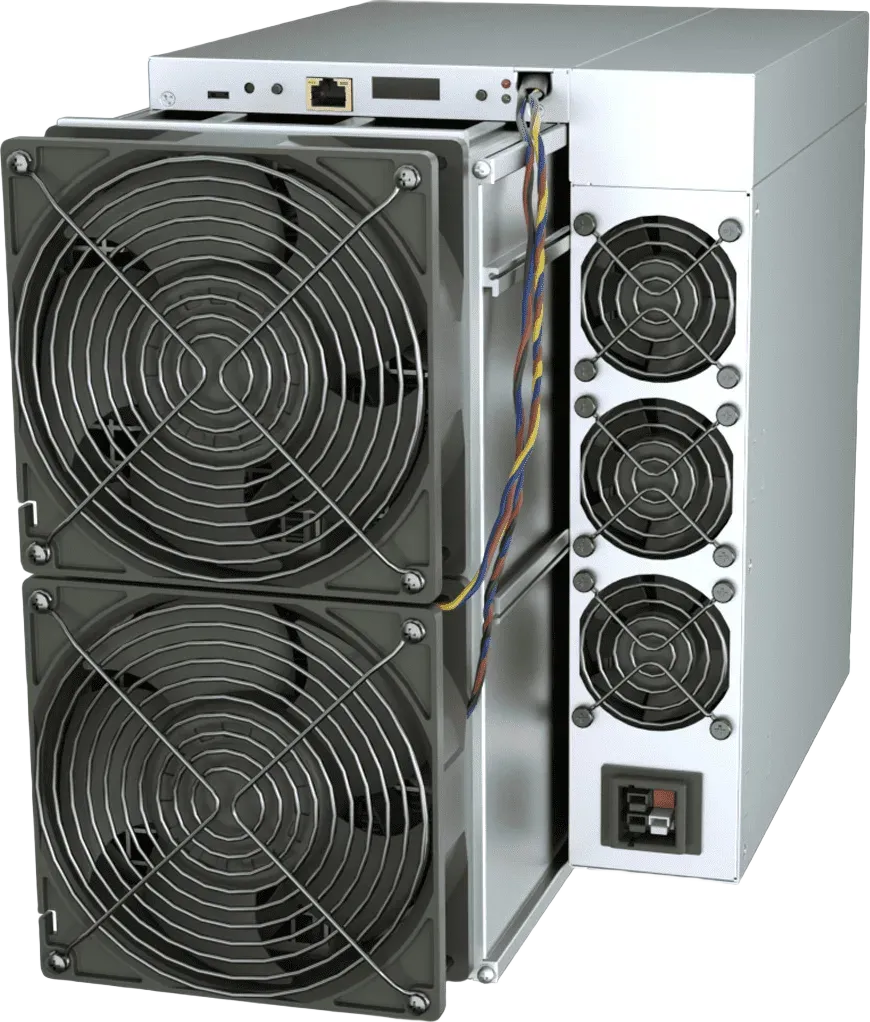
The Antminer S21 Pro 234 TH/s is rated at 234 TH/s.
- TH/s to GH/s: 234 × 1,000 = 234,000 GH/s
- TH/s to PH/s: 234 ÷ 1,000 = 0.234 PH/s
- TH/s to MH/s: 234 × 1,000,000 = 234,000,000 MH/s
kHeavyHash (Kaspa): IceRiver KS5M and KS0 Ultra
The IceRiver KS5M is rated at 15 TH/s, which is 15,000 GH/s. The smaller IceRiver KS0 Ultra is rated at 400 GH/s, which is 0.4 TH/s. So the KS5M does 37.5 times the hashrate of the KS0 Ultra (15,000 ÷ 400).
Scrypt (Litecoin and Dogecoin): Antminer L9
The Antminer L9 16 GH/s is rated at 16 GH/s. GH/s to MH/s: 16 × 1,000 = 16,000 MH/s. Older Scrypt machines are often quoted in MH/s, so converting both to the same unit makes them easy to compare.
RandomX (Monero): Antminer X9
The Antminer X9 is rated at 1 MH/s, which Bitmain also writes as 1,000 kH/s. MH/s to kH/s: 1 × 1,000 = 1,000 kH/s. Our Monero mining guide explains why RandomX numbers are so much smaller.
Why hashrate only compares within one algorithm
A hash is not a fixed amount of work. One SHA-256 hash, one kHeavyHash hash and one RandomX hash take very different amounts of computation. RandomX in particular is deliberately heavy and memory-bound. That is why a Bitcoin miner is quoted in TH/s while a Monero machine drawing a similar amount of power is quoted in kH/s or MH/s.
So 1 TH/s of SHA-256 is not comparable to 1 TH/s of kHeavyHash, and neither can be compared with Scrypt GH/s. Hashrate is only meaningful against other machines and the network on the same algorithm. A Kaspa miner cannot mine Bitcoin at any hashrate. To compare across algorithms, compare purchase price, power draw, noise and current network data instead. Our guide to SHA-256 covers the Bitcoin algorithm in more detail.
Fleet hashrate and share of the network
Fleet hashrate is simply units × hashrate per unit, converted to whatever unit is convenient:
- 10 × 234 TH/s = 2,340 TH/s = 2.34 PH/s = 0.00234 EH/s
- Fleet power: 10 × 3,510 W = 35,100 W, or 35.1 kW
Your share of the network is your hashrate divided by total network hashrate, with both in the same unit. Bitcoin network hashrate is usually reported in EH/s, so convert your fleet to EH/s first. For every 100 EH/s of network hashrate, a 0.00234 EH/s fleet is 0.00234% of the total. Network hashrate changes constantly and is published by block explorers and pool dashboards, so use a current figure. Our solo mining calculator turns that share into the odds of finding a block.
Efficiency units: J/TH, J/GH, J/MH and J/kH
Efficiency is power divided by hashrate. One watt is one joule per second, so J/TH is the same as watts per TH/s. A miner rated at 15 J/TH uses 15 W for every TH/s it produces. Lower is better.
The efficiency units follow the same 1,000 ladder, but in the opposite direction. A larger hashrate unit means a larger number of joules per unit:
| Miner | Listed efficiency | Converted |
|---|---|---|
| Antminer S21 Pro 234 TH/s | 15 J/TH (3,510 W ÷ 234 TH/s) | 0.015 J/GH |
| IceRiver KS5M | 226.67 J/TH | about 0.227 J/GH |
| Antminer L9 16 GH/s | 210 J/GH | 0.21 J/MH |
| Antminer X9 | 2.47 J/kH | about 2,472 J/MH |
To convert: J/TH ÷ 1,000 = J/GH, and J/GH ÷ 1,000 = J/MH. Going the other way, multiply by 1,000. As with hashrate, efficiency only compares within one algorithm. The X9’s 2,472 J/MH does not mean it is less efficient than the L9; the two machines run completely different work. For more on these units, see our guide to hashrate, terahash and J/TH.
From hashrate to running costs
Once your units match, hashrate and power feed directly into cost estimates. Daily energy is kW × 24, so the 35.1 kW fleet above uses about 842 kWh per day. Use our ASIC miner profitability calculator for SHA-256 and other machines, or the Kaspa mining calculator for kHeavyHash units, with current network data and your own electricity rate. Bitminers does not guarantee mining profitability.
Frequently asked questions
What is kH/s?
kH/s means kilohashes per second: 1 kH/s is 1,000 hashes per second, and 1,000 kH/s make 1 MH/s. Modern Bitcoin and Kaspa miners are rated in TH/s, so kH/s mostly appears on CPU mining and RandomX hardware: Bitmain rates the Antminer X9 at 1,000 kH/s, which is 1 MH/s.
How many GH/s are in 1 TH/s?
1 TH/s equals 1,000 GH/s. To convert TH/s to GH/s, multiply by 1,000. To convert GH/s to TH/s, divide by 1,000.
How do I convert MH/s to GH/s?
Divide by 1,000. For example, 16,000 MH/s is 16 GH/s, which is the rating of the Antminer L9 16 GH/s.
Is 1 TH/s on Kaspa the same as 1 TH/s on Bitcoin?
No. Kaspa uses kHeavyHash and Bitcoin uses SHA-256, so the hashes are different units of work. Compare hashrate only between machines on the same algorithm.
What does J/TH mean?
Joules per terahash, which is the same as watts per TH/s. A 15 J/TH miner draws 15 W for each TH/s of hashrate.