
Solo Mining Calculator: Bitcoin Solo Chance per Block, Day and Year
Short answer: a solo mining calculator turns your hashrate and the Bitcoin network’s hashrate into odds. Your chance on any single block is your hashrate divided by the network hashrate; your chance of at least one block over a period is 1 − (1 − p)^n, where n is the number of blocks in that period. Enter your miner’s hashrate and today’s network hashrate below to see your share of the network, your solo chance per block, per day, per 30 days and per year, and the average time between blocks at that share.
Solo mining calculator
This Bitcoin solo mining calculator only does arithmetic on the numbers you enter. It fetches no live network data, so the result is a snapshot for the figures you typed, not a forecast. It works out odds only; it does not estimate the value of a block. Bitminers does not guarantee mining profitability.
This calculator only works out probabilities from the numbers you enter. Network hashrate changes constantly, and each block is an independent chance: past attempts do not make a find more likely.
Where to find the network hashrate
Bitcoin’s network hashrate is an estimate, not a measured figure: it is inferred from the current difficulty and how quickly recent blocks have arrived. Public block explorers and mining pool dashboards publish it, usually in EH/s, and figures differ a little between sites because each uses its own averaging window. Pick one source and use it consistently.
Keep the units straight. 1 EH/s (exahash per second) is 1,000 PH/s, or 1,000,000 TH/s. Small open-source miners are often rated in GH/s; 1,200 GH/s is 1.2 TH/s. Our guide to hashrate units and J/TH covers the conversions in more detail.
If a source only lists difficulty, the Bitcoin Wiki difficulty page gives the relationship: average time between blocks = difficulty × 2^32 ÷ hashrate. Rearranged for a 600-second block, network hashrate ≈ difficulty × 2^32 ÷ 600 hashes per second.
The math behind the solo chance
Every hash has the same chance of producing a valid block, so the network behaves like a single large draw every block, with your miner holding a share of the tickets. The Bitcoin Wiki’s difficulty page makes the same point: every hash attempt has the same chance of success as any other. The calculator uses three formulas:
- Chance per block: p = your hashrate ÷ network hashrate (both in the same unit).
- Chance of at least one block in n blocks: 1 − (1 − p)^n. A day is about 144 blocks, 30 days about 4,320, and a year (365.25 days) about 52,596.
- Average time between blocks at your share: 1 ÷ (p × 144) days.
Why 144? Bitcoin targets one block every 10 minutes, and difficulty is retargeted every 2,016 blocks. The Bitcoin developer guide gives the ideal time for those 2,016 blocks as 1,209,600 seconds, which is two weeks or 600 seconds per block, so 24 × 6 = 144 blocks a day. Between retargets, real block times run faster when hashrate is rising and slower when it is falling, which is why the blocks-per-day field can be edited.
For small p, 1 − (1 − p)^n is almost exactly p × n, the expected number of blocks in the period. The full formula matters only when the result approaches tens of percent, which no home-sized unit does.
Worked examples for home miners
Illustration only: the table assumes a round network hashrate of 1,000 EH/s (1,000,000,000 TH/s). That is not a reading of today’s network; enter the current figure in the calculator for real numbers. Hashrates are the listed figures on Bitminers product pages at the time of writing (October 2026).
| Miner (listed hashrate) | Share of network | Chance per block | At least one block in a day | In 30 days | In a year | Average time between blocks |
|---|---|---|---|---|---|---|
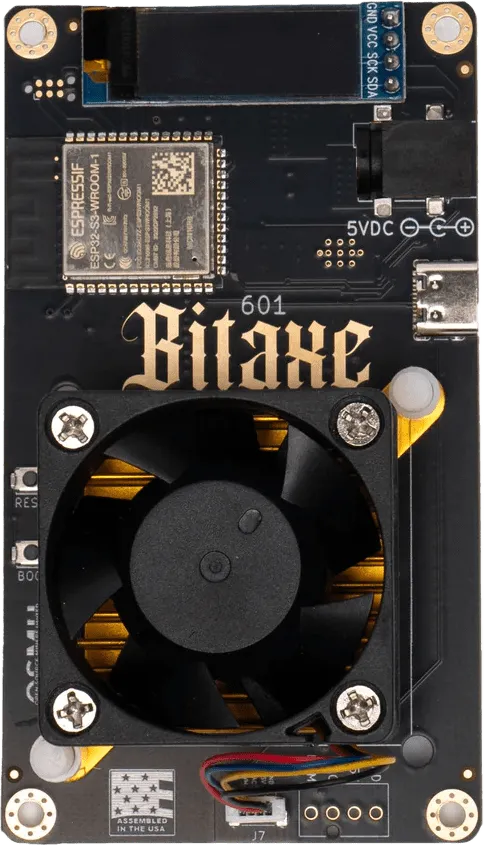
| Bitaxe Gamma 601 (1.2 TH/s) | 0.00000012% | 1 in 833 million | 1 in 5.8 million | 1 in 193,000 | 1 in 15,800 | about 15,800 years |
| NerdQaxe++ (4.8 TH/s) | 0.00000048% | 1 in 208 million | 1 in 1.45 million | 1 in 48,200 | 1 in 3,960 | about 3,960 years |
| Canaan Avalon Nano 3S (6 TH/s) | 0.0000006% | 1 in 167 million | 1 in 1.16 million | 1 in 38,600 | 1 in 3,170 | about 3,170 years |
| Canaan Avalon Mini 3 (37.5 TH/s) | 0.00000375% | 1 in 26.7 million | 1 in 185,000 | 1 in 6,170 | 1 in 508 | about 507 years |
| Canaan Avalon Q (90 TH/s) | 0.000009% | 1 in 11.1 million | 1 in 77,200 | 1 in 2,570 | 1 in 212 | about 211 years |
The odds scale linearly with hashrate: the Avalon Q’s 90 TH/s gives 75 times the chance per block of a 1.2 TH/s Bitaxe. If the network hashrate doubles, every figure in the table halves. The full range of desk-sized units is in our home and solo miners category.
Each block is a fresh draw
No block is ever “due”. Your miner does not build up progress toward a block: each block attempt starts from zero, and a hash that misses leaves no partial credit. After a year without a block, your chance on the next block is exactly what it was on day one, provided your hashrate and the network’s stay the same. The only things that move your odds are your hashrate, the network hashrate and how long you keep mining.
The same is true of the “average time between blocks”. It is a long-run mean across many hypothetical miners, not a countdown for yours. A miner can find a block in its first hour or never in its working life.
Why the luck variance is so large
When each block is an independent draw with a tiny chance, the wait for a first block follows a geometric (close to exponential) distribution. Two results follow directly from that math:
- The chance of still having no block after one full average wait is about 37% (e^−1). After three average waits it is still about 5%.
- The median wait is about 69% of the average (ln 2), because a few very long waits pull the average up.
For a home miner whose average wait is measured in centuries, those spreads are wider than any human timescale. That is the trade-off pools exist to remove; our guide to how mining pools and shares work and the FPPS vs PPS vs PPLNS comparison explain how pooled payouts smooth it out.
Pointing a miner at a solo pool
To mine solo without running your own node, you point the miner at a solo pool and use your Bitcoin address as the username. Setup is covered step by step in our CKPool solo mining guide and Public Pool solo mining guide. For how solo and pooled mining differ, and what a lottery miner is, see solo Bitcoin mining and lottery miners. Treat the running cost as the cost of a hobby, not an investment.
Frequently asked questions
How do I calculate my solo mining odds?
Divide your hashrate by the network hashrate in the same unit to get p, your chance per block. For a period of n blocks, the chance of at least one block is 1 − (1 − p)^n, with about 144 blocks per day.
What is the solo chance for a 1 TH/s miner?
It depends on the network hashrate you enter. As an illustration at 1,000 EH/s, 1 TH/s is a one-in-a-billion chance per block and roughly 1 in 19,000 over a year. Enter the current network figure for a real estimate.
Does a long run without a block improve my odds?
No. Each block attempt is independent, so past misses do not change the next block’s chance. Only your hashrate, the network hashrate and time spent mining change the odds.
Why does the calculator use 144 blocks per day?
Bitcoin targets one block every 10 minutes, which is 144 a day. Actual block times drift between difficulty retargets every 2,016 blocks, so you can change the figure.
Do solo mining odds change at different solo pools?
No. The pool does not change your chance per block; that depends only on your hashrate and the network’s. Pools differ in fees, payout terms and how they handle stale shares.