
OCEAN Mining Pool Explained: TIDES Payouts, DATUM and Setup
Short answer: OCEAN (ocean.xyz) is a Bitcoin mining pool operated by Bitcoin Ocean, LLC. It pays miners with a scheme called TIDES, which splits each block the pool finds across a large window of recent shares, and it pays miners directly in the block’s generation (coinbase) transaction instead of holding their funds. You connect with mine.ocean.xyz:3334 and your Bitcoin address as the username; no account is needed.
This guide covers what is specific to OCEAN: TIDES, non-custodial payouts, Lightning payouts, block templates and DATUM, published fees and setup. For the basics of shares and pool payout schemes, start with our overview of mining pools and how shares work. Pool facts below come from OCEAN’s own website and documentation as read on October 4, 2026; pool terms change, so check ocean.xyz before you connect. Bitminers does not guarantee mining profitability.
What OCEAN is and who runs it
OCEAN’s site states that it is operated by Bitcoin Ocean, LLC, a subsidiary of Mummolin, Inc., a Wyoming corporation. Its press releases date from November 2023 (a seed round led by Jack Dorsey), with Lightning payouts added in April 2024 and DATUM in September 2024.
Three design choices set it apart from a typical pool:
- TIDES payouts instead of FPPS or classic PPLNS.
- Non-custodial payouts: miners are paid by outputs in the block’s generation transaction whenever possible.
- Miner-built templates: with DATUM, a miner can build block templates on their own Bitcoin node.
TIDES: how OCEAN pays for shares
TIDES stands for Transparent Index of Distinct Extended Shares. According to the OCEAN TIDES documentation, the pool keeps a share log of every valid share in the order received. When the pool finds a block, the reward is split in proportion to each miner’s shares inside the share log window:
- Your part of a block = (your shares in the window ÷ total shares in the window) × that block’s reward, rounded down to the nearest satoshi.
The window is sized at eight times the block’s difficulty worth of shares. OCEAN states that this gives each share a 99.9665% chance of being rewarded at least once, and that on average a share is rewarded eight times. Shares are not removed from the log after a block; a share keeps being paid for every block found while it is still inside the window, so it can be paid more or fewer than eight times depending on the pool’s luck.
Because the reward is divided by percentage rather than paid as a set amount per share, the block’s actual transaction fees are included. OCEAN’s FAQ contrasts this with PPLNS implementations that use “shifts” and much smaller windows, and with FPPS, which needs the pool to act as a custodial intermediary.
A round-number illustration
Say your shares make up 0.001% of the window when the pool finds a block. You are credited 0.001% of that block’s subsidy plus fees. If the pool finds another block while most of those shares are still in the window, you are credited again at your new percentage. In a dry spell, nothing is credited until the next block. So TIDES payouts vary from day to day, as PPLNS payouts do; the long window smooths that variation. Our FPPS vs PPS vs PPLNS comparison covers the general maths of who carries luck.
Non-custodial payouts from the coinbase
OCEAN’s FAQ says it constructs blocks so that miners are paid in the generation transaction whenever possible: the Bitcoin network pays miners directly, and OCEAN coordinates the split. As an example, the FAQ points to a block found by the pool in 2026 whose generation transaction contains 57 outputs. A few rules follow from this:
- 100-block maturity. Newly mined coins, including coinbase outputs paid to you, cannot be spent for 100 blocks. This is a Bitcoin protocol rule, not an OCEAN rule.
- On-chain payout threshold. OCEAN lists the threshold as 0.01048576 BTC (1,048,576 sats). Below it, your rewards accumulate until the threshold is exceeded, and the payout then happens automatically.
- If you stop or change address. OCEAN says it will attempt discretionary payouts for balances at or above 0.00065536 BTC when practical, and reserves the right to change this policy.
With a small home miner, reaching the on-chain threshold can take a long time, which is where Lightning comes in.
Lightning payouts with BOLT12
OCEAN pays below the on-chain threshold over Lightning if you configure a BOLT12 offer. Its Lightning documentation lists three requirements: a Lightning node that supports BOLT12, enough inbound liquidity and open channels to receive payments, and a wallet that can sign a Bitcoin message with the key of your mining address. You generate a message in the OCEAN dashboard, sign it in your wallet and submit the signature. If a Lightning payment fails for lack of liquidity, OCEAN retries every block until your balance reaches the on-chain threshold, then pays on-chain instead.
Block templates and DATUM
A block template is the list of transactions a miner works on, and at most pools the operator builds it. OCEAN’s template documentation says it once offered alternate pool-built templates (Core, Core+Antispam and Data-Free) and decommissioned them on December 21, 2025. The remaining pool template, “OCEAN Recommended”, is described as including “only transactions and reasonably small data”.
The alternative is DATUM (Decentralized Alternative Templates for Universal Mining). With DATUM you run your own Bitcoin node and the DATUM Gateway software, your miners connect to the gateway on your network (port 23334 in OCEAN’s setup guide), and your node chooses what goes into the block while you keep mining as part of the OCEAN pool. OCEAN recommends Bitcoin Knots for the node because it offers more template controls, and its setup page lists DATUM as a public beta.
OCEAN fees as published
| How you mine on OCEAN | Connection | Published pool fee |
|---|---|---|
| OCEAN Recommended template | mine.ocean.xyz:3334 or default.mine.ocean.xyz:3101 | 2% |
| Your own template via DATUM | Your DATUM Gateway (OCEAN’s guide uses port 23334) | 1% (OCEAN calls it a 50% discount) |
How to connect a miner to OCEAN
OCEAN’s get started page and FAQ describe a two-field setup with no account:
- Pool URL: enter mine.ocean.xyz:3334. Some miners need the stratum+tcp:// prefix; others ask for the port (3334) in a separate field.
- Worker or username: enter your Bitcoin address. To name a worker for the stats page, add a period and a name, such as bitcoinaddress.worker1. Without a name, the worker shows as “default”.
- Password: anything; OCEAN suggests “x” and ignores it.
Every OCEAN miner is identified by that address. OCEAN accepts addresses starting with 1, 3 or bc1 (including Taproot). The pool does not check that the username is a valid Bitcoin address, and an invalid one receives nothing, so paste it carefully and use an address you control. Any SHA-256 miner can connect this way; the setup flow on a small unit is covered in our Bitaxe setup guide.
OCEAN compared with FPPS, PPLNS and solo pools
| OCEAN (TIDES) | Typical FPPS pool | Typical PPLNS pool | Solo pool | |
|---|---|---|---|---|
| Paid from | Blocks the pool finds | Pool balance, per share | Blocks the pool finds | Only blocks your miner finds |
| Transaction fees | Actual fees in each block | Estimated average | Actual fees in each block | All fees in your block |
| Who carries luck | Miners, smoothed by an 8× window | Pool operator | Miners | You alone |
| Custody | Coinbase outputs to your address when possible | Pool holds balances | Varies by pool | Usually coinbase to your address |
| Account | Bitcoin address only | Usually required | Usually required | Usually address only |
The OCEAN pool is a shared pool, not a solo pool: your shares earn a slice of every block the pool finds, not the whole of a block you find. If you want the all-or-nothing approach instead, see solo mining and lottery miners.
Hardware for pooled mining
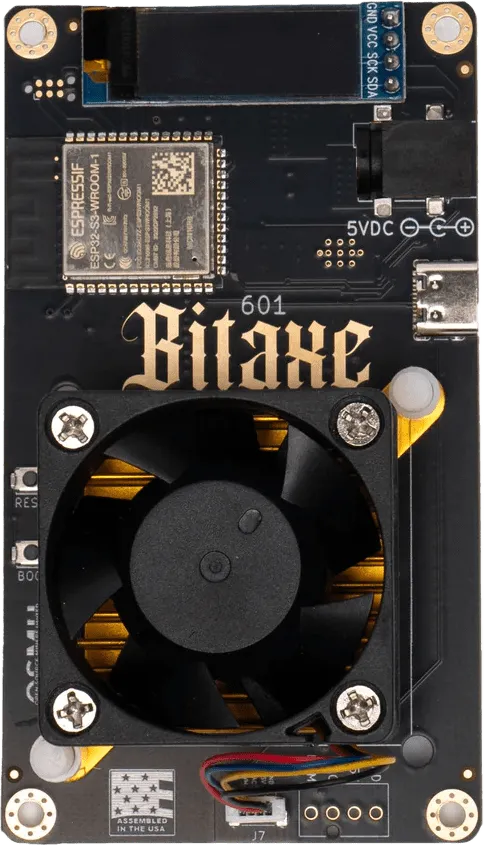
How many shares you submit depends on your hashrate in TH/s. Bitminers prices at the time of writing (October 4, 2026): the Bitaxe Gamma 601 (1.2 TH/s, 17 W) is $77.17, the NerdQaxe++ (4.8 TH/s, 76 W) is $279.00, the Canaan Avalon Q (90 TH/s, 1,674 W) is $1,291.64 and the Antminer S21 Pro (234 TH/s, 3,510 W, 15.0 J/TH) is $2,379.00. Compare more desk-sized units in our home and solo miners category.
Frequently asked questions
Is OCEAN a solo mining pool?
No. OCEAN shares each block it finds among all miners with shares in the TIDES window. Every miner’s payout comes from pool blocks, not only from blocks their own hardware finds.
Do I need an account to mine on OCEAN?
No. OCEAN says no account is necessary: you enter a Bitcoin address as the username, optionally followed by a period and a worker name.
What is the OCEAN payout threshold?
OCEAN lists 0.01048576 BTC (1,048,576 sats) for on-chain payouts. Smaller balances accumulate until they pass it, or can be paid earlier over Lightning with a BOLT12 offer.
What fee does OCEAN charge?
OCEAN publishes a 2% fee for its own template and 1% for miners who build their own templates with DATUM. Check ocean.xyz for current terms before you connect.
How is TIDES different from PPLNS?
Both pay from blocks the pool actually finds. TIDES uses a window of eight times the block difficulty worth of shares, keeps shares in the log so each is paid about eight times on average, and divides the full block reward, fees included, by percentage.