
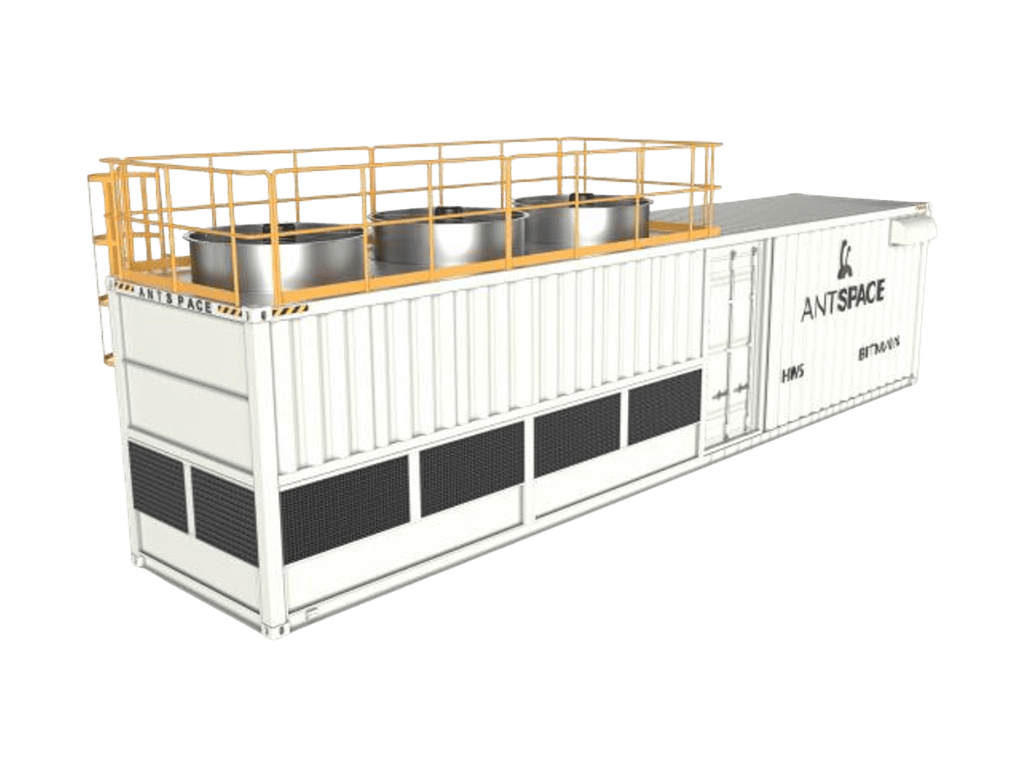
Crypto Mining Containers Explained: Air, Hydro and Bitmain Antspace
Short answer: a crypto mining container is a shipping-container-sized enclosure fitted out to run ASIC miners: racks, power distribution, cooling, networking and monitoring arrive pre-built, and you supply a prepared pad, a power feed and, for liquid-cooled models, water. Containers come in air-cooled, hydro-cooled and immersion designs. Bitmain’s Antspace line is the hydro example: the Antspace HW5 holds 210 Antminer Hyd. miners and runs at 1,062 kW.
This guide explains what is inside a mining container, what to check before buying one, how Bitmain’s Antspace HW5 and HK3 compare, and which containers we list. It covers infrastructure only. Bitminers does not guarantee mining profitability.
What a mining container is
A mining container turns a steel box into a small data center. The common sizes are the 20-foot and 40-foot shipping-container footprints, so a unit can travel by truck and sit on a prepared pad. Instead of fitting out a building, you install the container, connect power and network, and load the miners. Our mining farm planning guide compares containers with buildings; this page looks at the containers themselves.
What is inside: the four systems
Power distribution
Incoming high-current cables feed a main distribution cabinet, which splits power through breakers and power distribution units (PDUs) to one outlet per miner. The cabinet’s rating sets the container’s ceiling. Bitmain’s Antspace HW5 specifications show the scale: two 1,200 A main switches, a rated current of up to 986 A, and up to 10 A per miner.
Cooling
Cooling decides most of the design:
- Air containers pull outside air through the miners with fans and exhaust it, often with hot-aisle and cold-aisle separation, filters and sometimes evaporative water curtains. They take standard air-cooled miners.
- Hydro containers pipe coolant through cold plates in hydro miners and reject the heat outside through a dry or dry-wet cooling tower. They only take hydro-cooled models.
- Immersion containers hold miners in tanks of dielectric fluid and move the heat out through heat exchangers. Our guide to immersion cooling for Bitcoin mining covers tanks and fluids.
For the trade-offs between the first two, see air cooling vs hydro cooling.
Monitoring
Containers carry sensors for temperature, humidity and power, plus a control system for fans, pumps and valves. Bitmain documents a dedicated control interface for its Antspace containers. Per-miner monitoring of hashrate and errors still runs through your own management software or pool dashboard.
Network
Every miner needs a wired Ethernet connection, so containers ship with switches and structured cabling. You bring the internet connection, ideally with a backup link.
Bitmain Antspace: HW5 and HK3
Antspace is Bitmain’s mining-container line. The two models with current specification sheets in Bitmain’s support library are hydro containers for its Hyd. Antminers:
| Antspace HW5 (V1) | Antspace HK3 (V6) | |
|---|---|---|
| Container length | 12,192 mm (40 ft) | 6,058 mm (20 ft) |
| Miner capacity | 210 S19 Hyd. and S21 Hyd. series | 210 S19 Hyd. and S21 Hyd. series |
| Operating power | 1,062 kW | 1,047-1,050 kW |
| PUE | 1.032 | 1.022 without tower, 1.032 with tower |
| Input voltage | 400 V ±5%, 50/60 Hz | 400 V ±5%, 50/60 Hz |
| Heat rejection | Dry-wet tower, 1,200 kW | Separate dry-wet tower container (1,000 kW), two dry towers, or a plate heat exchanger |
| Weight in operation | 24 t | 12 t (container only) |
| Units per 2,500 kVA transformer | 2 | 2 |
Sources: Bitmain’s HW5 specifications (linked above) and Antspace HK3 V6 specifications. Bitmain also documents an earlier HK3 V2 water-cooled container in its support library.
The practical difference: the HK3 is a 20-foot miner container paired with a separate cooling unit you choose, while the HW5 is a 40-foot unit specified together with its dry-wet tower. Both specification sheets list the same site conditions:
- Level ground (±1 degree) for the cooling tower, and a hardened surface that holds the container: at least 36 tonnes of load on the HW5 sheet, 25 tonnes on the HK3 V6 sheet.
- A 20-ton crane for unloading.
- Stairs, walkways, transformers, cables, cable bridges and distribution boxes are not included.
- At least 2 m of free air inlet space around the cooling tower.
- Operation below 2,000 m elevation, ambient −25 °C to 40 °C, and 10-90% relative humidity.
The HW5’s dry-wet tower is rated at 70 dBA at 15 m and uses 0.7-1.3 m³ of water per hour, which matters for permits and water supply. Bitmain also sells its own coolant, Antspace AZ, a glycol mix with a −40 °C freezing point that it says must be replaced every three years.
What to check before buying a mining container
- Power capacity in kW or MW. Add up the rated power of every miner the container will hold, plus cooling and auxiliaries. For example, 168 Antminer S21 units at Bitmain’s rated 3,500 W draw 588 kW before cooling. Your utility service must carry that continuously.
- Voltage and phase. Container cabinets are built for a specific three-phase supply; Bitmain specifies 400 V ±5% for the Antspace models. Confirm it matches what your utility delivers, or plan the transformer, which is usually not included.
- Cooling type. An air container needs air-cooled miners and a clean, dry intake; a hydro container needs hydro miners, a water supply for the tower and coolant maintenance.
- Miner compatibility. Check the container maker’s list of supported models, the outlet type (for example C19) and the per-miner current limit. Antspace containers are specified for Bitmain’s S19 Hyd. and S21 Hyd. series; our hydro-cooled miners category lists the hydro models we carry.
- Site preparation. Pad, crane access, cable runs from the transformer, drainage and clearance around cooling equipment.
- Permits. Expect zoning, building and electrical approvals, plus noise and water rules for cooling towers. Our guide Is crypto mining legal in the US? covers state and local considerations; requirements vary by location.
Mining containers on Bitminers
The mining containers category lists four units, at prices at the time of writing (October 4, 2026):
| Container | Type, per the listing | Price |
|---|---|---|
| 20FT Mining Container for 168pcs (S19kpro/S19/S21) | Air: water curtain and exhaust fans, hot and cold aisles, 168 miners | $25,117.74 |
| 20ft ASIC-162 Bitcoin Mining Container | Air with hot-air recirculation for cold climates; temperature, humidity and power monitoring; 162 miners | $40,878.09 |
| Bitmain Antspace HW5 V1 | Hydro, 40 ft, 210 Hyd. miners | $84,000.00 |
| Bitcoin container with 180x Antminer S21+ 235TH/s miners | Air, supplied with 180 Antminer S21+ units | $693,249.60 |
Only the last listing names miners as part of the product. Check each product page for what is included, and confirm the miners you plan to install match the container’s design. Containers are large freight items, so contact us before ordering to confirm site power, delivery access and lead time.
Frequently asked questions
How many miners fit in a mining container?
It depends on size and cooling. The air containers we list hold 162 to 180 miners in a 20-foot box, and Bitmain rates both the Antspace HW5 and HK3 for 210 hydro miners.
What is the difference between the Antspace HK3 and HW5?
The HK3 V6 is a 20-foot hydro container paired with a separate cooling tower, dry towers or a heat exchanger. The HW5 is a 40-foot unit specified with a 1,200 kW dry-wet tower. Both hold 210 Hyd. miners at about 1,050-1,062 kW.
Can I put air-cooled miners in an Antspace container?
Not as designed. Bitmain rates the Antspace HW5 and HK3 for S19 Hyd. and S21 Hyd. series hydro miners and recommends using them together. Air-cooled miners belong in an air container.
Does a mining container need three-phase power?
Yes, in practice. At hundreds of kilowatts per container, Bitmain specifies a 400 V three-phase supply with four 300 mm² cables per phase for the Antspace models.
Do I need a permit for a mining container?
Usually. Placing and powering a container typically needs zoning, building and electrical approvals, and cooling towers can bring noise and water rules. Check with your local authority.