
How to Plan a Bitcoin Mining Farm: Power, Cooling, Space and Containers
Short answer: a Bitcoin mining farm is a site that runs many ASIC miners together, from a few machines in a warehouse to containers holding more than a hundred units each. Planning one comes down to six things: enough electrical capacity delivered safely, a way to remove heat, noise and zoning that fit the location, reliable networking, monitoring, and the right permits. Settle power and cooling first; everything else follows from them.
This guide is a planning checklist. It covers infrastructure, not earnings, and it applies whether you are fitting out a building or buying a purpose-built mining container.
1. Power capacity
Power is the hard limit on any mining farm. Start by adding up the rated power of every miner you plan to run, then add cooling, networking, lighting and a safety margin.
Example arithmetic: 20 Antminer S21 XP units at 3,645 W each draw 72,900 W (72.9 kW) continuously. Over 24 hours that is about 1,750 kWh per day, before cooling and other loads.
Points to plan with a licensed electrician and your utility:
- Service capacity: whether the existing service, panel and transformer can carry the load, or whether the utility must upgrade them. Utility upgrades can take a long time, so ask early.
- Single-phase vs three-phase: homes and small buildings in the US usually have single-phase service, while many commercial and industrial sites have three-phase service. Three-phase power delivers large loads more efficiently and is common for bigger farms. Check each miner’s input voltage specification; most air-cooled units run on 200-240 V, and some hydro units are specified for higher-voltage or three-phase supply.
- Continuous load: miners run around the clock, and electrical codes treat that as continuous load, which affects how circuits and breakers must be sized. Do not load circuits to their full rating.
- Distribution: power distribution units (PDUs), cabling and breakers rated for the load, with clear labeling so each machine can be isolated.
- Tariff: your electricity rate structure, including demand charges and time-of-use pricing, matters as much as the headline price per kWh.
2. Cooling: air, hydro or immersion
Nearly every watt a miner draws becomes heat. Using the US Energy Information Administration conversion of 1 kWh = 3,412 Btu, the 72.9 kW example above produces roughly 248,700 Btu of heat per hour. Your cooling choice decides how you remove it.
| Cooling type | How it works | Site needs | Catalog example |
|---|---|---|---|
| Air | Fans pull air through the hashboards | Large intake and exhaust openings, filtered intake air, hot-air separation | Antminer S21 XP: 270 TH/s, 3,645 W, 75 dB |
| Hydro | Coolant flows through plates on the hashboards | Pumps, piping, dry coolers or cooling towers, water treatment | Antminer S23 Hyd: 580 TH/s, 5,510 W, 50 dB |
| Immersion | Miners sit in non-conductive fluid | Tanks, dielectric fluid, heat exchangers | Antminer S23 Immersion: 442 TH/s, 5,304 W, 50 dB |
Air cooling is the simplest to start with but is sensitive to dust, humidity and summer temperatures. Hydro and immersion cost more to set up but are quieter at the machine and handle denser installations. Our air cooling vs hydro cooling guide compares them in more detail.
3. Noise and zoning
Air-cooled miners are loud, typically around 75 dB per machine in the Bitminers catalog, and many machines together are louder still. Fans and dry coolers on hydro sites also make noise. Before committing to a site:
- Check local zoning: many areas restrict industrial or data-center use, and some states have passed laws that address crypto mining directly, such as requirements to reduce noise.
- Check noise ordinances, especially for night-time limits at the property line.
- Plan distance, barriers or sound attenuation if neighbors are close.
State and local rules vary widely. Our guide Is Crypto Mining Legal in the US? covers federal, state and local considerations.
4. Containers vs buildings
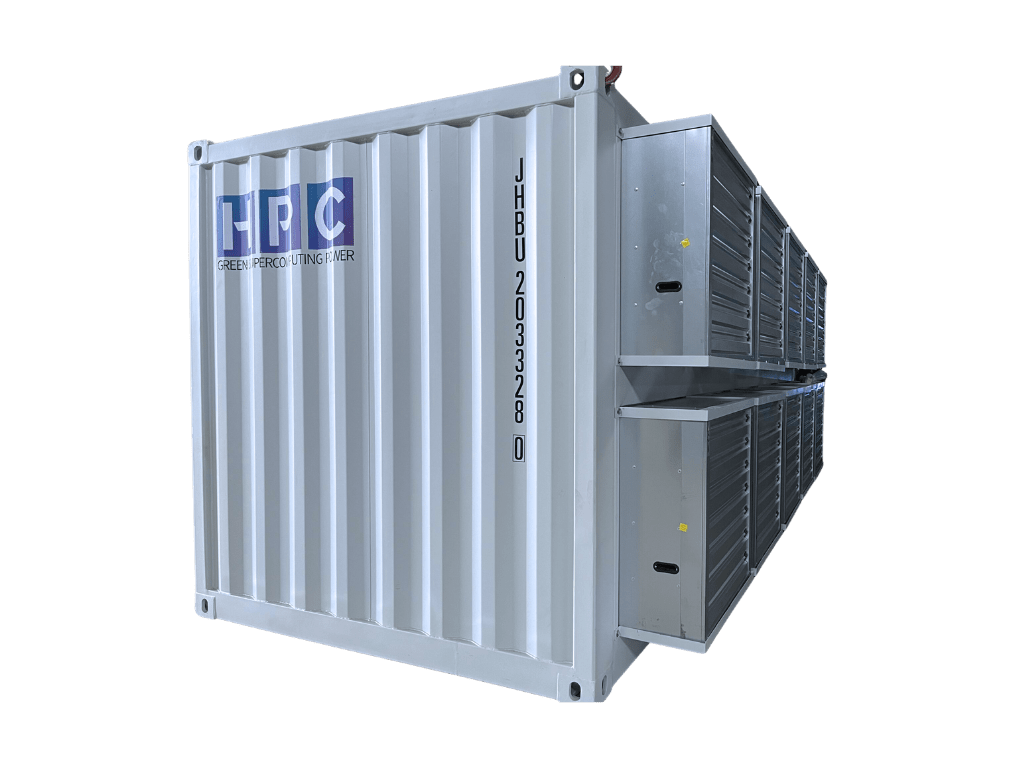
You can fit out an existing building or install purpose-built mining containers. Containers arrive with racks, power distribution and airflow or cooling designed for miners, while a building can be cheaper to rent but usually needs more custom electrical and ventilation work.
| Mining container | Existing building | |
|---|---|---|
| Setup | Pre-built layout; needs a prepared pad, power hookup and delivery access | Custom design for racks, ventilation and wiring |
| Scaling | Add containers in units | Limited by floor space and the building’s electrical service |
| Relocation | Can be moved by truck | Fixed |
| Permits | Still needs site, electrical and possibly zoning approval | May need change-of-use, building and electrical permits |
Containers in the Bitminers mining containers category, at Bitminers prices at the time of writing (October 2, 2026):
| Product | Price |
|---|---|
| 20FT Mining Container for 168pcs (S19kpro/S19/S21) | $25,117.74 |
| 20ft ASIC-162 Bitcoin Mining Container | $40,878.09 |
| BITMAIN Antspace HW5 V1 | $84,000.00 |
| Bitcoin container with 180x Antminer S21+ 235TH/s miners | $693,249.60 |
Check each product page for what is included, and confirm that the miners you plan to install match the container’s design.
5. Networking
- Wired Ethernet for every miner: miners need little bandwidth, but connections must be stable.
- Switches with enough ports and spare capacity for growth, placed away from hot exhaust air.
- Address management: reserve IP addresses so each machine can be found by location.
- Separation and security: keep miners on their own network segment and change every default password.
- Backup connection: a second internet link prevents a single outage from stopping the whole farm.
6. Monitoring and operations
- Machine monitoring: track hashrate, temperatures and errors per machine, and set alerts for drops.
- Environmental sensors: intake and exhaust temperature, humidity and, for hydro, coolant temperature and flow.
- Remote power control: switched PDUs let you restart a stuck machine without a site visit.
- Safety and security: fire detection suited to electrical equipment, cameras, access control and a written emergency shut-off procedure.
- Spares and records: keep spare fans and cables, and log each machine’s serial number and position.
7. Permits and paperwork
- Building and electrical permits, plus inspections, for new circuits and structures.
- Utility service agreements for large loads.
- Zoning approval or confirmation of permitted use.
- Insurance that covers the equipment and the activity.
- Tax records: mined coins are generally taxable income in the US.
Ordering and delivery
Bitminers sells new hardware only and ships within the US. The store states a $120 flat shipping rate per order within the US, with dispatch 5-10 business days after payment; see the shipping policy for details. Containers are large freight items, and the containers category page asks buyers to contact the store before ordering to confirm site power and delivery access. Prepare the pad, the route for the truck and a way to unload before the container ships. Mining revenue depends on network conditions and electricity costs, and Bitminers does not guarantee mining profitability.
Frequently asked questions
How much power does a small mining farm need?
Add the rated power of each miner, then add cooling and other loads plus a margin. For example, 20 air-cooled miners at 3,645 W each draw about 73 kW before cooling.
Do I need three-phase power for a mining farm?
Not always. Small farms of air-cooled miners can run on single-phase 240 V circuits, but larger sites and some hydro miners are better suited to three-phase service. A licensed electrician and your utility can tell you what is available at your site.
Is a mining container better than a building?
Neither is better in every case. Containers are faster to deploy and easier to scale or move; buildings can use existing space but need more custom work. Power availability at the site usually decides.
What should I do before ordering a mining container?
Confirm power capacity, permits, the pad and truck access at your site, then contact Bitminers to confirm site power and delivery access before placing the order.