
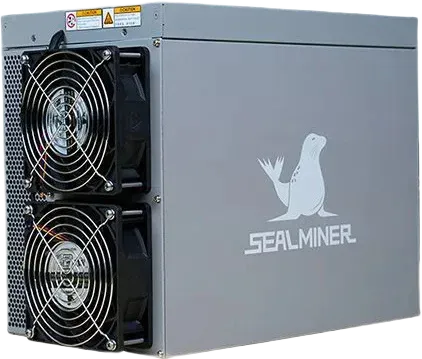
Bitdeer SealMiner Models Explained: A1 to A4, Pro, Air and Hyd
Short answer: SealMiner is Bitdeer’s own line of SHA-256 Bitcoin miners, built around chips Bitdeer designs in-house. The letter and number give the generation (A1, A2, A3, A4), “Pro” marks the more efficient version of a generation, and “Air” or “Hyd” (short for Hydro) tells you whether the unit is fan-cooled or liquid-cooled. For example, Bitdeer rates the air-cooled SealMiner A2 at 226 TH/s and 16.5 J/TH and the hydro-cooled A3 Pro Hydro at 660 TH/s and 12.5 J/TH.
This guide decodes the names, lists Bitdeer’s rated hashrate, power and efficiency for each SealMiner model, and explains what the air and hydro versions need on site. Bitminers does not guarantee mining profitability.
On this page
Who Bitdeer is
Bitdeer Technologies Group (Nasdaq: BTDR) is a Singapore-headquartered Bitcoin mining company that also designs its own ASIC miners. It runs datacenters in the United States, Norway and Bhutan, where it mines with its own SealMiners, and it also sells the machines to outside customers. In its August 2025 operations update, Bitdeer reported 6.0 EH/s of SealMiner A2 machines shipped to external customers.
That makes Bitdeer different from most miner makers. It is a mining operator first and a hardware maker second, and it uses each new SealMiner generation in its own fleet. Every SealMiner listing we carry is grouped on our Bitdeer brand page.
How to read a SealMiner model name
Take the SealMiner A3 Pro Hyd as an example and read it in four parts:
- A: every SealMiner model so far starts with it.
- 3: the generation. Higher numbers are newer and more efficient: A2 launched in October 2024, A3 in September 2025 and A4 in April 2026.
- Pro: the higher-efficiency version within that generation. The A3 Pro is rated at 12.5 J/TH against 13.5 J/TH for the A3 Hydro and 14 J/TH for the A3 Air. In the A4 series Bitdeer added an “Ultra” tier above Pro.
- Hyd: the cooling. Bitdeer’s own name is “Hydro”; store listings, including ours, often shorten it to “Hyd”. “Air” means the unit cools itself with fans. The original A2 has no suffix and is air-cooled.
Store listings then add the hashrate bin, as in “SealMiner A2 Pro Hyd, 506 TH/s”. Every SealMiner mines SHA-256, so it works on Bitcoin, Bitcoin Cash and Bitcoin SV.
Bitdeer’s SEAL chips
SealMiners run on Bitdeer’s own SEAL chips, and each generation of machine follows a generation of chip:
- SEAL01: Bitdeer announced the SEAL01 in March 2024: a 4-nanometer chip that tested at 18.1 J/TH, built for the SealMiner A1.
- SEAL02: the 4 nm chip inside the SealMiner A2.
- A3 series: Bitdeer describes it only as using its self-developed SEAL series chips.
- SEAL04: used in the A4 series. In August 2025 Bitdeer said it was targeting a chip efficiency of about 5 J/TH for SEAL04.
Chip efficiency is measured at the chip. It is always lower than the J/TH of the finished machine at the wall, which also covers the power supply, fans or pumps, and control board. Compare machines on the wall figure in the table below. Our guide to hashrate, terahash and J/TH explains the units.
Bitdeer’s ratings for each SealMiner model
Figures are Bitdeer’s published ratings from its launch announcements. Where Bitdeer gives a range, the table shows the range. Bitdeer quotes tolerances of ±10% on hashrate and power and ±5% on efficiency for the A2 Pro, A3 and A4 series.
| Model | Rated hashrate | Power | Efficiency | Cooling | Launched |
|---|---|---|---|---|---|
| A2 | 226 TH/s | 3,730 W* | 16.5 J/TH | Air | Oct 2024 |
| A2 Hyd (A2 Hydro) | 446 TH/s | 7,359 W | 16.5 J/TH | Hydro | Oct 2024 |
| A2 Pro Air | 255-270 TH/s | 3,790-4,050 W | 14.9 J/TH | Air | Mar 2025 |
| A2 Pro Hyd | 500-530 TH/s | 7,450-7,900 W | 14.9 J/TH | Hydro | Mar 2025 |
| A3 Air | 260 TH/s | 3,360-3,920 W | 14 J/TH | Air | Sep 2025 |
| A3 Pro Air | 290 TH/s | 3,250-4,000 W | 12.5 J/TH | Air | Sep 2025 |
| A3 Hyd (A3 Hydro) | 500 TH/s | 6,210-7,290 W | 13.5 J/TH | Hydro | Sep 2025 |
| A3 Pro Hyd (A3 Pro Hydro) | 660 TH/s | 7,875-8,625 W | 12.5 J/TH | Hydro | Sep 2025 |
| A4 Pro Air | 336 TH/s | 3,662 W | 10.9 J/TH | Air | Apr 2026 |
| A4 Pro Hydro | 680 TH/s | 7,412 W | 10.9 J/TH | Hydro | Apr 2026 |
| A4 Ultra Hydro | 886 TH/s | 8,373 W | 9.45 J/TH | Hydro | Apr 2026 |
*Bitdeer’s A2 announcement gives the hashrate and J/TH. The 3,730 W figure comes from independent spec databases and matches 226 TH/s at 16.5 J/TH.
A1: the first-generation SealMiner A1 is not in the table. In its June 2024 roadmap, Bitdeer said it expected the A1 to come in between 20 and 23 J/TH at the wall. By August 2025 it reported 4.1 EH/s of A1 machines energized in its own datacenters. We found no single per-unit hashrate rating from Bitdeer, so we do not quote one.
A3 versus A3 Pro: get the cooling right
Each A3 name covers two machines with very different hashrates, so check the cooling suffix before you compare prices:
- A3 Air: 260 TH/s. A3 Hydro: 500 TH/s.
- A3 Pro Air: 290 TH/s. A3 Pro Hydro: 660 TH/s.
Our A3 listings are both hydro units: the SealMiner A3 Hyd, 500 TH/s and the SealMiner A3 Pro Hyd, 660 TH/s. If you see an “A3 Pro” quoted at 660 TH/s anywhere, it is the Hydro model, not the air one.
Air versus hydro SealMiners in practice
The air and hydro versions of a generation share a name but suit very different sites.
Air (no suffix, or “Air”)
Air units draw about 3.3-4.1 kW and push heat out through their own fans. The SealMiner A2 at 3,730 W is roughly 15.5 A at 240 V, so it needs a dedicated circuit sized for continuous load plus a ventilation path that brings in cool air and exhausts hot air. Spec databases list the A2 and A2 Pro Air at about 75 dB, so plan a space away from living areas.
Hydro (“Hyd” or “Hydro”)
Hydro units roughly double the hashrate per machine but draw about 6.2-8.6 kW. They have no cooling of their own: each one must be connected to a liquid loop with a pump, piping and a dry cooler or heat exchanger. For the A2 Pro Hyd, Bitdeer specifies inlet water up to 60 °C and outlet up to 70 °C. The A3 hydro models are specified for 380-480 V three-phase power.
Efficiency does not always change with cooling. The A2 Pro and A3 Pro are rated at the same J/TH in air and hydro form, while the A3 Hydro (13.5 J/TH) is slightly more efficient than the A3 Air (14 J/TH). Read air cooling vs hydro cooling before you plan a site, and browse our hydro-cooled miners to compare loads.
SealMiner listings on Bitminers
Bitminers prices at the time of writing (October 4, 2026), using each listing’s hashrate:
- SealMiner A2, 226 TH/s (air): $3,183.27. Other A2 bins from 224 to 232 TH/s are listed at $3,130.84 to $3,291.34.
- SealMiner A2 Pro Air, 255 TH/s (air): $3,068.00
- SealMiner A2 Hyd, 446 TH/s (hydro): $7,188.00
- SealMiner A2 Pro Hyd, 500 TH/s (hydro): $5,919.00. Bins from 502 to 526 TH/s are listed at $5,977.99 to $6,737.37.
- SealMiner A3 Hyd, 500 TH/s (hydro): $6,749.00
- SealMiner A3 Pro Hyd, 660 TH/s (hydro): $9,590.00
We do not list the A4 series at the time of writing. When comparing listings, weigh J/TH, the power and cooling your site can supply, and purchase price, and use current hashprice and electricity data rather than fixed estimates. Bitminers does not guarantee mining profitability.
How SealMiners compare with other makers
SealMiners compete in the same SHA-256 class as Bitmain’s Antminer and MicroBT’s Whatsminer machines, and all three makers offer both air-cooled and hydro-cooled models. Our guides to the Antminer S21 series and Whatsminer model numbers list those makers’ ratings in the same format, so you can compare J/TH and power draw across brands.
Frequently asked questions
Who makes the SealMiner?
Bitdeer Technologies Group, a Singapore-headquartered company listed on Nasdaq as BTDR. It designs both the SEAL chips and the SealMiner machines, and it mines with them in its own datacenters.
What is the difference between the SealMiner A2 and A2 Pro?
The A2 Pro is the more efficient version. Bitdeer rates the air-cooled A2 at 226 TH/s and 16.5 J/TH, and the A2 Pro Air at 255-270 TH/s and 14.9 J/TH.
What does Hyd mean on a SealMiner?
It is short for Hydro, meaning the unit is liquid-cooled. It needs an external coolant loop and higher-voltage power, and it delivers about twice the hashrate of the air version of the same generation.
Is the SealMiner A3 Pro air-cooled or hydro-cooled?
Both versions exist. The A3 Pro Air is rated at 290 TH/s and the A3 Pro Hydro at 660 TH/s, both at 12.5 J/TH. Our 660 TH/s listing is the Hydro model.
Does Bitminers sell the SealMiner A4?
Not at the time of writing. Bitdeer launched the A4 series in April 2026, and its top model, the A4 Ultra Hydro, is rated at 886 TH/s and 9.45 J/TH.