
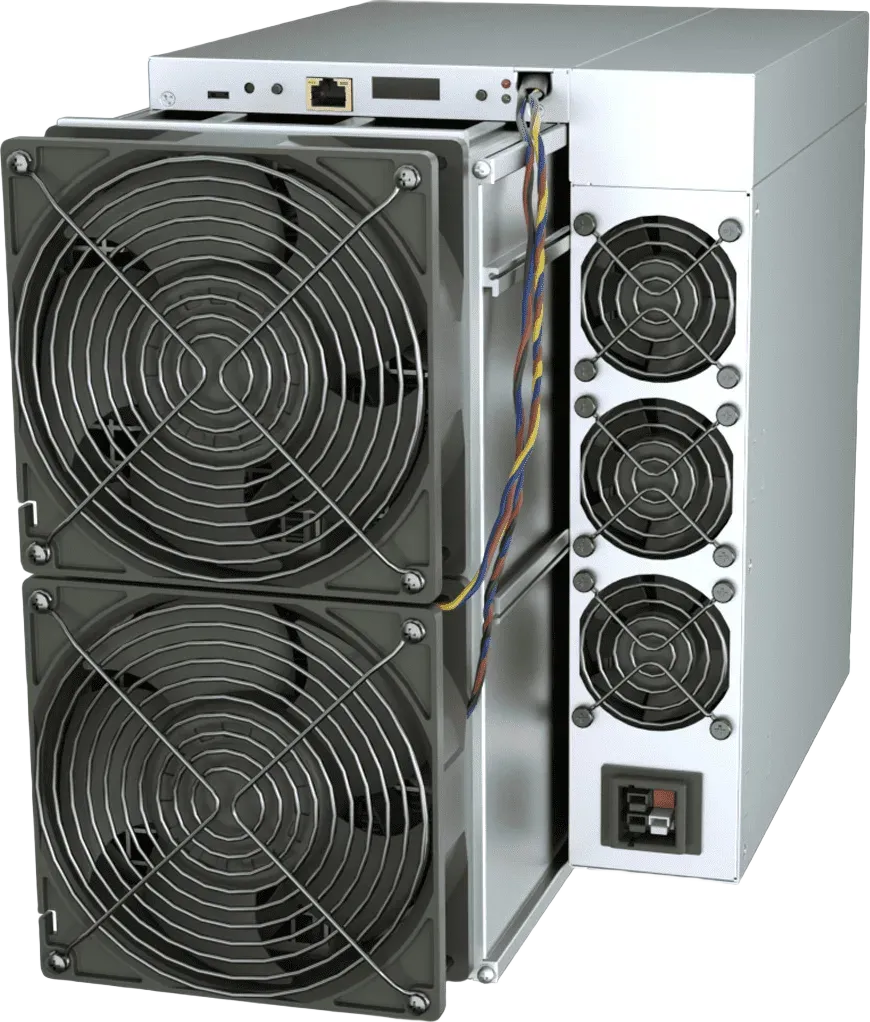
Antminer Explained: What Bitmain’s Model Names, Letters and Suffixes Mean
Short answer: Antminer is the brand name Bitmain puts on its ASIC miners. The number in a model name marks the generation, and the suffixes (Pro, +, XP, Hyd, Immersion, 3U) describe the tier, the cooling and the chassis. The first letter tells you the algorithm, and so the coins it can mine:
- S models hash SHA-256 for Bitcoin.
- L models hash Scrypt for Litecoin and Dogecoin.
- KS models hash kHeavyHash for Kaspa.
- Z models hash Equihash for Zcash.
Bitmain states its ratings as typical values, so compare models on joules per terahash (J/TH) and read the tolerances on the spec sheet.
This guide is for anyone comparing Antminer models before buying. It decodes the letters and suffixes using the models we stock and shows how to read a Bitmain specification sheet. It is built from Bitmain’s published specifications and our catalog, not hands-on testing.
On this page
What is an Antminer?
Bitmain is a mining-hardware company with R&D centers in Beijing, Shanghai, Shenzhen and Singapore. By its own account it has built mining servers since its foundation in 2013 and sells them under the Antminer brand; the Bitmain About page states both. Every Antminer is an ASIC miner, a machine built around chips that do one hashing job and nothing else, and Bitmain publishes a specification sheet for each model on its support site. Those sheets are the source for the ratings in this guide.
Because the brand covers many algorithms, “Antminer” on its own does not tell you what a machine mines. The model name does. All of the Bitmain hardware we carry is grouped on our Bitmain brand page.
How do Antminer model names work?
An Antminer name has three parts: a letter (or two), a number, and optional suffixes. In “Antminer S21 XP Hyd”, S is the algorithm family, 21 is the generation, and XP and Hyd mark the efficiency tier and the cooling.
What does the letter tell you about algorithm and coins?
These are the families we list; the algorithm and coin pairings come from our catalog.
- S: SHA-256, for Bitcoin (BTC), Bitcoin Cash (BCH) and Bitcoin SV (BSV): the S19, S21 and S23. The T21 is also a SHA-256 Bitcoin miner, listed at 19 J/TH.
- L: Scrypt, for Litecoin (LTC) and Dogecoin (DOGE), which can be mined together: the L7, L9 and L11.
- KS: kHeavyHash, for Kaspa (KAS): the KS5, KS5 Pro and KS7.
- KA: Blake2S, for Kadena (KDA): the KA3. The Kadena organization stopped maintaining the network in October 2025; independent miners still run it.
- K on its own: Eaglesong, for Nervos (CKB): the K7.
- Z: Equihash, for Zcash (ZEC): the Z15 and Z15 Pro (Horizen, once also mined on Equihash, ended proof-of-work mining in July 2025).
- E: Etchash, for Ethereum Classic (ETC): the E9 Pro and E11.
- X: RandomX, for Monero (XMR): the X5 and X9.
- D: X11, for Dash (DASH): the D9.
What does the number tell you?
Within one letter, a higher number is a newer generation, and each generation so far has lowered the rated J/TH. In our catalog the S19 family is listed at 19 to 34.21 J/TH, the S21 family at 11 to 17.5 J/TH and the S23 family at 9.5 to 12 J/TH. The Scrypt line follows the same pattern: 0.36 J/MH for the L7, 210 J/GH (0.21 J/MH) for the L9 and 165 to 184 J/GH for the L11.
What do the suffixes tell you about tier, cooling and chassis?
Bitmain does not publish a glossary for its suffixes, so the meanings below are read from its specification tables: what changes between the model with and without each suffix.
- Pro: a higher-rated version of the same base model. The S21 Pro is listed at 15 J/TH against 17.5 J/TH for the S21, and the Z15 Pro at 840 KSol/s against 420 KSol/s for the Z15.
- + (Plus): an improved version of the model it follows. The S21+ is listed at 16.5 J/TH, between the S21 and the S21 Pro; the S19j Pro+ at 27.5 J/TH against 29.5 J/TH for the S19j Pro.
- XP: the most efficient tier of a generation: 21.5 J/TH for the S19 XP against 29.5 J/TH for the S19 Pro, and 13.5 J/TH for the S21 XP against 15 J/TH for the S21 Pro.
- e: Bitmain does not state what the letter means, so treat it as a revision marker. In our catalog it appears only on hydro models, each listed slightly less efficient than its counterpart: the S21e Hyd at 17 J/TH against 16 J/TH for the S21 Hyd, and the S23e Hyd 2U at 10 J/TH against 9.5 J/TH for the S23 Hyd.
- j and k: revision marks on the S19 platform, also undefined by Bitmain. The S19j Pro (2021) is listed at 29.5 J/TH, the same as the S19 Pro; the S19k Pro (2023) at 23-25 J/TH on a lower power draw.
- Hyd: hydro cooling. Liquid coolant flows through the hashboards instead of fans blowing air across them. Bitmain’s S21 XP Hyd sheet specifies 380-415 V three-phase power, an inlet water temperature of 20-50 °C, a flow of 8-10 L/min and antifreeze, deionized or pure water as the working fluid.
- Immersion: built to run submerged in a tank of dielectric oil, also on three-phase power.
- 2U, 3U and 6U: rack-mount chassis measured in rack units (U), the height increment of a standard 19-inch equipment rack. The S21e XP Hyd 3U, S23 Hyd 3U, S23e Hyd 2U and the L11 Hyd 2U and 6U are rack units; Bitmain’s own names put the U first, as in U3S21EXPH and U3S23H.
Store listings add the hashrate bin after the name, as in “S21 Pro 234 TH/s”. Bitmain often sells one model in several bins at the same J/TH, so the bin changes hashrate and power but not efficiency.
Which SHA-256 generations do we list?
Ranges are the lowest and highest J/TH listed in our catalog for each family, air and liquid-cooled models together.
| Family | First listed release | Catalog J/TH range | Cooling types listed | Guide |
|---|---|---|---|---|
| Antminer S19 | May 2020 | 19-34.21 J/TH | Air, hydro | S19 series explained |
| Antminer S21 | October 2023 | 11-17.5 J/TH | Air, hydro, immersion | S21 series explained |
| Antminer S23 | January 2026 | 9.5-12 J/TH | Air, hydro, immersion | S23 series explained |
Lower J/TH means less electricity for each terahash of work. Every model we stock is in the Antminer S19, Antminer S21 or Antminer S23 category.
Which Antminer families do we list?
As an example of a single listing, the Antminer S21 Pro 234 TH/s is listed at 234 TH/s, 3,510 W and 15 J/TH, air-cooled, at 75 dB. The Bitminers price at the time of writing (October 5, 2026) is $2,379.00. Bitminers does not guarantee mining profitability.
The table gives the lowest and highest values across our listings for each family. Hashrate units differ by algorithm, so compare only within a row.
| Family | Algorithm | Coins | Catalog hashrate | Catalog power | Cooling | Where to find it |
|---|---|---|---|---|---|---|
| S19 | SHA-256 | BTC, BCH, BSV | 95-512 TH/s | 2,645-10,600 W | Air, hydro | S19 category |
| S21 | SHA-256 | BTC, BCH, BSV | 188-860 TH/s | 3,290-11,180 W | Air, hydro, immersion | S21 category |
| S23 | SHA-256 | BTC, BCH, BSV | 318 TH/s-1.16 PH/s | 3,498-11,020 W | Air, hydro, immersion | S23 category |
| L7 | Scrypt | LTC, DOGE | 8,050-9,500 MH/s | 2,900-3,420 W | Air | L7 category |
| L9 | Scrypt | LTC, DOGE | 16-17 GH/s (U2L9H rack: 27 GH/s) | 3,360-5,670 W | Air; hydro rack | L9 category |
| L11 | Scrypt | LTC, DOGE | 20-35 GH/s | 3,680-5,775 W | Air; hydro 2U and 6U | Antminer L11 20 GH/s |
| KS5 / KS5 Pro | kHeavyHash | KAS | 20-21 TH/s | 3,050-3,150 W | Air | Kaspa miners |
| KA3 | Blake2S | KDA | 166-173 TH/s | 3,154-3,287 W | Air | Other ASIC miners |
| Z15 / Z15 Pro | Equihash | ZEC, ZEN | 420-840 KSol/s | 1,510-2,780 W | Air | Z15 category |
| E9 Pro | Etchash | ETC | 3.58-3.78 GH/s | 2,200-2,260 W | Air | ETC miners |
| X9 | RandomX | XMR | 1 MH/s | 2,472 W | Air | Other ASIC miners |
How do you read a Bitmain spec sheet?
Every Antminer specification page on Bitmain’s support site follows the same layout. Five rows matter most when you compare models.
- Typical hashrate. Bitmain calls its figures typical values. The S21 Pro specification states that the actual hashrate fluctuates by ±3%, and the S21 XP Hyd sheet carries the same note. A 234 TH/s rating therefore covers roughly 227 to 241 TH/s.
- Power on wall. The same sheets state that power and efficiency fluctuate by ±5%. Air-cooled ratings are given at 25 °C inlet air and hydro ratings at 35 °C inlet water. The sheet also lists the input current your circuit must support: 20 A single-phase for the S21 Pro, 12 A three-phase for the S21 XP Hyd.
- Efficiency in J/TH. Power divided by hashrate: 3,510 W ÷ 234 TH/s = 15 J/TH. This is the number to compare across models, because a higher hashrate at a worse J/TH simply uses more electricity. Our guide to hashrate, terahash and J/TH and the hashrate converter cover the units, including GH/s, MH/s and KSol/s for the other families.
- Input voltage. Bitmain’s sheets put Antminers in three classes.
- Older air-cooled models (S19, S19 Pro, L7, KA3, Z15 Pro, E9 Pro, X5) list 200-240 V AC single-phase.
- Newer air-cooled models (S21, S23, L9, L11, KS5, KS7, X9) list 220-277 V AC single-phase.
- Hyd and Immersion models list 380-415 V AC three-phase, and the L11 Hyd racks 380-480 V three-phase.
Bitmain warns that a wrong input voltage can damage the unit, so confirm your supply with an electrician before ordering a Hyd model.
- Noise. Listed in dBA at 25 °C. Air-cooled Antminers in our catalog are listed at 72-76 dB and hydro units at 50 dB; the figure covers the machine alone, not the pumps and dry cooler a hydro unit needs.
Firmware, warranty and buying notes
Antminers ship with Bitmain’s stock firmware and a web interface for pool settings and monitoring; our guide to ASIC miner firmware explains the stock software, the third-party alternatives and how flashing affects coverage. Bitminers sells new units only, covered by our warranty policy; read it before changing firmware or opening a case. For what to check before ordering from any seller, see our guide on where to buy ASIC miners.
Frequently asked questions
What is an Antminer?
An Antminer is an ASIC miner made by Bitmain, a mining-hardware company that by its own account has built mining servers since 2013. Each Antminer is built around chips that do one hashing job and nothing else, and the model name, not the brand, tells you which algorithm and coins it mines: S models for SHA-256 (Bitcoin), L models for Scrypt (Litecoin and Dogecoin), KS for kHeavyHash (Kaspa), and so on.
What is the difference between an Antminer S model and an L model?
The letter is the algorithm. S models hash SHA-256 for Bitcoin, Bitcoin Cash and Bitcoin SV; L models hash Scrypt for Litecoin and Dogecoin. An S miner cannot mine Litecoin, and an L miner cannot mine Bitcoin.
What do Pro, XP and + mean on an Antminer?
They mark tiers within a generation. In the S21 family, Bitmain rates the S21 at 17.5 J/TH, the S21+ at 16.5 J/TH, the S21 Pro at 15 J/TH and the S21 XP at 13.5 J/TH: XP is the most efficient tier, Pro sits below it, and + is a step up from the base model.
How accurate are Bitmain’s hashrate and power ratings?
Bitmain gives them as typical values. Its specification sheets state that actual hashrate fluctuates by ±3% and that power and efficiency fluctuate by ±5%, measured at 25 °C inlet air for air-cooled models and 35 °C inlet water for hydro models.