
What Is Aleo? Aleo Crypto, Proving and Aleo Mining Explained
Short answer: Aleo is a layer-1 blockchain built for private applications. It uses zero-knowledge proofs so that a program’s inputs and results can stay hidden while the network still verifies that the computation is correct. Aleo Mainnet went live on September 18, 2024, and its native token is called Aleo Credits (ALEO). “Aleo mining” really means proving: provers solve a puzzle by generating SNARK proofs and receive a share of each block’s reward, while validators run the AleoBFT consensus.
What is Aleo?
Most public blockchains show every transaction to everyone. Aleo takes a different approach. On Aleo, a computation can run off-chain and produce a compact proof that it was done correctly. The network checks that proof instead of re-running the work, and the inputs, outputs and balances behind it can stay hidden. The Aleo Network Foundation describes it as a layer-1 smart contract blockchain that is zero-knowledge by default, and it announced in its mainnet launch post that Aleo Mainnet went live on September 18, 2024.
The network’s token goes by two names in the official material, Aleo Credits and Aleo tokens, with the ticker ALEO. Users pay it as fees to have transactions processed, it can be staked with validators, and the protocol issues it as rewards to provers and validators.
How Aleo consensus and proving work
Aleo splits the work of running the network between two groups:
- Validators stake Aleo Credits and run AleoBFT, which Aleo’s documentation describes as a DAG-based Byzantine Fault Tolerant system inspired by the Narwhal mempool and Bullshark ordering protocols. Validators order transactions and produce blocks, and once a block is committed it is final.
- Provers supply computing power. They solve the coinbase puzzle, which Aleo bases on the Proof of Succinct Work (PoSW) model. The puzzle is designed to mimic the work of creating a SNARK proof for a network transaction, which rewards hardware that is efficient at proof generation.
Unlike Bitcoin, the coinbase reward is not winner-take-all. Multiple provers receive a portion of the coinbase reward in proportion to the number of valid puzzle solutions they submit. The puzzle also changes every epoch (360 blocks), so provers switch to the new puzzle each time.
What an Aleo miner (prover) does
An Aleo miner is a machine that runs the prover side of this system. In practice it does three things:
- Fetches the current puzzle for the epoch, usually from a proving pool.
- Runs the heavy math behind SNARK proofs to search for solutions that meet the network’s difficulty target.
- Submits valid solutions so they can be counted toward the block reward.
Since July 31, 2025, one more rule applies. Under ARC-0046, implemented in snarkOS v4.0.0, a prover must have Aleo Credits staked to be eligible to submit solutions. The required stake is set per solution per epoch and rises in quarterly steps through July 2027 under the schedule in the ARC-0046 announcement. Two solutions per epoch need twice the stake of one. The ARC also describes how proving pools can meet the requirement on behalf of their members. Read the current rules before you buy hardware, because they affect how individual provers can take part.
GPUs vs ASICs for Aleo
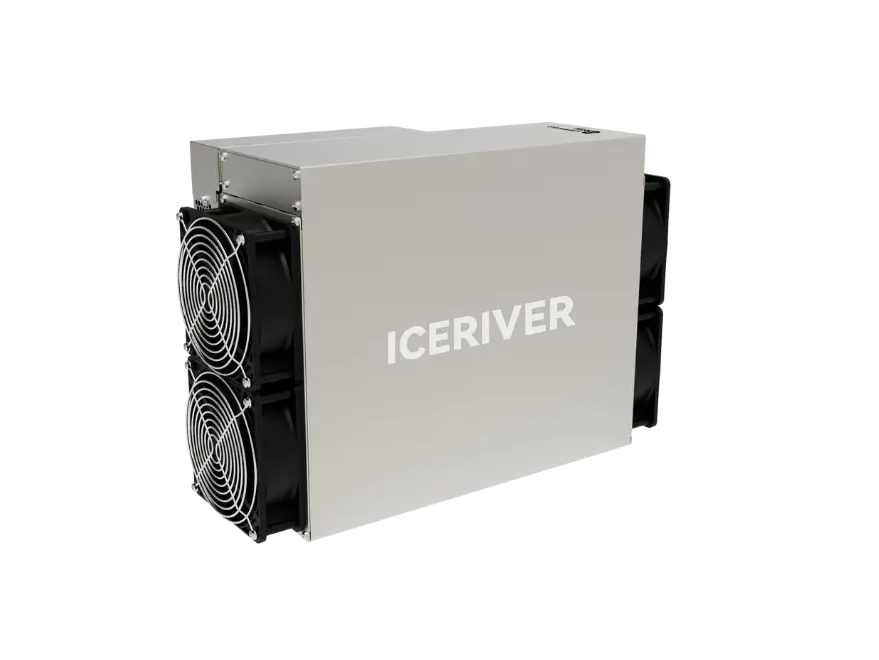
When mainnet launched, Aleo said more than 100,000 GPUs were solving PoSW puzzles. Graphics cards were the standard prover hardware through the testnets and the launch. In 2025, IceRiver and Goldshell released dedicated zkSNARK ASICs for Aleo. As with other proof-of-work style networks, a purpose-built chip does this one job with far less energy per unit of work than a general-purpose card. If you are new to the idea, our guide to what an ASIC miner is covers the basics.
Aleo hashrate is quoted in MH/s or GH/s, and efficiency in joules per megahash (J/MH): power in watts divided by MH/s. A lower J/MH means less electricity for the same work. Our hashrate converter guide explains how to move between MH/s and GH/s.
Aleo ASIC miners compared
The models below are from our Aleo miners category. Hashrate, power, efficiency and noise are the listed ratings on each product page. “Not listed” means we do not publish that figure. Prices are the Bitminers price at the time of writing (October 5, 2026) and can change.
| Miner | Hashrate | Power | Efficiency | Noise | Price |
|---|---|---|---|---|---|
| IceRiver Aleo AE3 | 2 GH/s | 3,400 W | 1.70 J/MH | 75 dB | $5,699.00 |
| IceRiver AE2 | 720 MH/s | 1,300 W | 1.81 J/MH | 50 dB | $2,599.00 |
| IceRiver ALEO AE1 Lite | 300 MH/s | 500 W | 1.67 J/MH | 45 dB | $979.00 |
| IceRiver ALEO AE0 | 60 MH/s | 100 W | 1.667 J/MH | not listed | $154.00 |
| Goldshell AE MAX II | 540 MH/s | 3,200 W | 5.93 J/MH | 85 dB | $1,581.79 |
| Goldshell E-AE1M | 230 MH/s | 2,000 W | 8.696 J/MH | not listed | $1,095.80 |
| Goldshell AE-BOX II | 54 MH/s | 530 W | 9.81 J/MH | 35 dB | $220.00 |
Two things stand out. First, on these listed ratings the IceRiver machines sit around 1.7-1.8 J/MH, while the Goldshell models range from about 5.9 to 9.8 J/MH, so the Goldshell units use several times more electricity for each MH/s. Second, the machines fall into two size classes. The AE3 and AE MAX II are full-size units drawing more than 3 kW at 75-85 dB. The AE1 Lite, AE0 and AE-BOX II draw 530 W or less and are listed at 35-45 dB where a figure is published. The category page also lists other Goldshell AE-BOX versions and the original AE MAX.
Power and electricity planning
Work out power before anything else. Machine wattage tells you both the circuit you need and your energy use.
- Current draw: divide watts by volts. The AE3 at 3,400 W draws about 14.2 A at 240 V, which calls for a dedicated 240 V circuit sized for continuous load. The AE1 Lite at 500 W draws about 4.2 A at 120 V.
- Input voltage: IceRiver specifies 200-250 V AC for the AE3 and 100-240 V AC for the AE1 Lite and AE2. The Goldshell AE-BOX II runs on 12 V DC from a separate power supply.
- Energy use: kilowatts times 24 gives kWh per day. The AE3 uses about 81.6 kWh per day and the AE1 Lite about 12 kWh per day. Multiply by your own electricity rate to get the daily cost.
- Heat and noise: nearly all of that power ends up as heat. A 75-85 dB full-size unit belongs in a garage, outbuilding or server room with good airflow, not a living space.
Have a licensed electrician confirm that your wiring and breaker can carry the load around the clock.
Proving pools
Most Aleo provers join a proving pool rather than run alone. The pool distributes the current puzzle, collects solutions from many machines and splits the rewards it receives among members, minus a fee. With the ARC-0046 stake requirement, the pool’s approach to staking matters too, so check how a pool handles it before you point hardware at it. Compare the pool’s fee, payout method, minimum payout and server locations. Our guide to how mining pools work explains the common payout models. We do not recommend a specific Aleo pool.
Costs and expectations
What a prover receives depends on the ALEO price, total network proving power, the current coinbase reward, pool fees, the staking rules and your electricity price. All of these change, and network data is published by Aleo block explorers and pool dashboards. Use current figures and test your own numbers with our ASIC miner profitability calculator. Bitminers does not guarantee mining profitability.
Frequently asked questions
Is Aleo proof of work or proof of stake?
Both roles exist. Validators stake Aleo Credits and run AleoBFT consensus to produce blocks. Provers do the computing work by solving the coinbase puzzle, which is based on Proof of Succinct Work, and since July 2025 they must also have stake to submit solutions.
When did Aleo mainnet launch?
The Aleo Network Foundation announced that Aleo Mainnet was live on September 18, 2024.
Can I mine Aleo with a GPU?
GPUs were the main prover hardware at launch and can still run the puzzle. Dedicated zkSNARK ASICs released in 2025 do the same work with much less energy per MH/s, so most new hardware is ASIC-based.
Which Aleo miner has the lowest listed noise?
Among the models above, the Goldshell AE-BOX II is listed at 35 dB and the IceRiver AE1 Lite at 45 dB. The full-size AE3 and AE MAX II are listed at 75 dB and 85 dB.
Can an Aleo miner mine Bitcoin or Kaspa?
No. An Aleo ASIC is built for the zkSNARK proving work of the Aleo puzzle. Bitcoin needs a SHA-256 miner and Kaspa needs a kHeavyHash miner.