
What Is Alephium? ALPH, Blake3 and Alephium Mining Explained
Short answer: Alephium is a proof-of-work layer-1 blockchain with smart contracts and built-in sharding. Its native token is ALPH, and its mainnet launched on November 8, 2021. Miners secure it with the Blake3 hash function, and the project’s consensus design is called Proof-of-Less-Work. ALPH can be mined with graphics cards or with dedicated Blake3 ASIC miners, usually connected to a mining pool.
What is Alephium?
Alephium is a layer-1 network, meaning it runs its own chain rather than sitting on top of another one. The project describes three main building blocks:
- BlockFlow sharding. Instead of one chain, the network is split into address groups. Alephium’s mining documentation states that it currently has 4 address groups and 16 chains, and blocks are produced on all of them in parallel.
- A stateful UTXO model. Balances are tracked as unspent outputs, as in Bitcoin, but contracts can hold state, which is what makes smart contracts possible.
- Its own contract stack. Contracts are written in a language called Ralph and run on Alephium’s own virtual machine.
The native token, ALPH, pays transaction fees and is the block reward miners receive. The project dates its mainnet launch to November 8, 2021.
Block time
Block times have shortened over the network’s life. The Danube network upgrade, which activated on July 15, 2025 according to the Danube upgrade documentation, cut the target block time on each chain from 16 seconds to 8 seconds. With 16 chains producing blocks in parallel, the project gives an average of about 2 blocks per second across the network.
Blake3 and Proof-of-Less-Work
Alephium is a proof-of-work chain: miners hash block candidates until one meets the difficulty target, as in Bitcoin. If you want the background on that model, see our guide to proof of work vs proof of stake.
Blake3
The hash function is Blake3, a general-purpose cryptographic hash released in 2020. Its official repository describes it as based on an optimized instance of BLAKE2 and lists four designers: Jack O’Connor, Samuel Neves, Jean-Philippe Aumasson and Zooko. Alephium has explained that it chose an established hash function rather than inventing a custom one. Because Blake3 is used for Alephium mining, “Blake3 miner” and “Alephium miner” mean the same thing in practice.
Proof-of-Less-Work
Proof-of-Less-Work (PoLW) is the project’s name for an adjustment to standard proof of work. As Alephium describes it, PoLW is designed to switch on once the network passes 1 EH/s of accumulated hashrate. From that point, part of the cost of producing a block is paid by burning ALPH as part of block validation rather than only by spending electricity on hashing. The project says this lowers the energy the network needs for a given level of security compared with ordinary proof of work. That is the project’s own design claim; whether it applies at any moment depends on whether the network has reached the activation threshold, which you can check on Alephium explorers.
How Alephium mining works
From a miner’s point of view, Alephium works like other proof-of-work coins, with a few specifics:
- Many small blocks. With 16 chains and an 8-second target on each, the network produces a large number of blocks a day, each carrying a small reward.
- Locked rewards. The mining documentation states that mined coins are locked for 500 minutes before they can be spent.
- Solo or pool. Solo mining runs through your own full node, and the node creates a miner wallet with one address per address group, so 4 addresses in all. Pool mining means pointing your miner at a pool and using one wallet address, following the pool’s instructions.
The project’s mining documentation also keeps a non-exhaustive, community-driven list of pools and advises miners to research a pool’s security and reputation before using it. Our guide to how mining pools work explains shares and payout schemes. Bitminers does not recommend a specific Alephium pool.
GPUs vs ASICs
Alephium publishes GPU miner software for Nvidia and AMD cards, so graphics cards can still mine ALPH. In 2024, IceRiver, Goldshell and DragonBall Miner released dedicated Blake3 ASICs. A chip built for one hash function is designed to deliver far more hashrate per watt than a general-purpose card.
Alephium (Blake3) miners compared
The models below are every Blake3 miner in our catalog. Hashrate and power are the listed ratings on each product page. Efficiency is shown in joules per gigahash (J/GH); where a product page lists J/TH, we divided by 1,000 so all rows use the same unit, and lower means less electricity per unit of work. None of these product pages lists a noise rating, so that column reads “not listed”. Prices are the Bitminers price at the time of writing (October 5, 2026) and can change. Most of these sit in our Alephium miners category.
| Miner | Hashrate | Power | Efficiency | Noise | Price |
|---|---|---|---|---|---|
| IceRiver AL3 | 15 TH/s | 3,500 W | 0.233 J/GH | not listed | $2,176.50 |
| Goldshell AL MAX | 8.3 TH/s | 3,350 W | 0.404 J/GH | not listed | $2,429.00 |
| Goldshell E-AL1M | 4.4 TH/s | 1,800 W | 0.409 J/GH | not listed | $1,529.00 |
| DragonBall A11 (dual-algorithm) | 3.2 TH/s | 2,300 W | 0.719 J/GH | not listed | $1,269.00 |
| IceRiver AL2 Lite | 2 TH/s | 500 W | 0.25 J/GH | not listed | $750.00 |
| Goldshell AL-BOX III | 1.25 TH/s | 600 W | 0.48 J/GH | not listed | $450.00 |
| Goldshell AL-BOX II Plus | 1 TH/s | 480 W | 0.48 J/GH | not listed | $403.00 |
| Goldshell AL-BOX II Pro | 950 GH/s | 460 W | 0.484 J/GH | not listed | $820.00 |
| IceRiver ALPH AL0 | 400 GH/s | 100 W | 0.25 J/GH | not listed | $179.00 |
Reading the table
- Efficiency splits by maker. On these listed ratings, the three IceRiver models sit at 0.233-0.25 J/GH, while the Goldshell models range from about 0.40 to 0.48 J/GH. The Goldshell units use roughly 1.6 to 2 times more electricity for each GH/s.
- The DragonBall A11 is a dual-algorithm machine. Its listing gives the algorithm as SHA512256d / Blake3, switchable, for Radiant (RXD) and Alephium (ALPH), and it sits in our other ASIC miners category. The 3.2 TH/s and 0.719 J/GH figures are its SHA512256d (Radiant) rating. In Blake3 mode, the spec sources we checked rate the same unit at about 1.2 TH/s at the same 2,300 W, so do not compare its 3.2 TH/s directly with the Blake3-only models above.
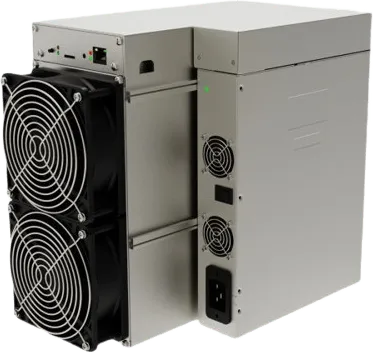
- Size classes. The AL3 and AL MAX draw more than 3 kW and are full-size machines. The E-AL1M sits in the middle at 1,800 W. The AL2 Lite, AL-BOX models and AL0 draw 600 W or less.
Power planning: 120 V or 240 V?
Check the input voltage before you order. These figures come from the manufacturers’ published specifications:
- IceRiver ALPH AL0: 100-240 V AC with its power supply. At 100 W it draws under 1 A at 120 V and uses about 2.4 kWh per day.
- IceRiver AL2 Lite: 100-240 V AC. At 500 W it draws about 4.2 A at 120 V and uses about 12 kWh per day.
- Goldshell AL-BOX II Plus and AL-BOX III: 12 V DC from a separate power supply that plugs into the wall. At 600 W, the AL-BOX III’s supply draws about 5 A at 120 V.
- Goldshell E-AL1M: 110-240 V AC. At 1,800 W it draws about 15 A at 120 V, which is too much for a shared 15 A household circuit running around the clock. Plan for a dedicated circuit, or 240 V, where it draws about 7.5 A.
- IceRiver AL3: 200-250 V AC, so it needs a 240 V circuit. At 3,500 W it draws about 14.6 A and uses about 84 kWh per day.
- Goldshell AL MAX, AL-BOX II Pro and DragonBall A11: we could not confirm the input voltage from a manufacturer source. Check the product page or ask us before buying.
Watts divided by volts gives amps, and kilowatts times 24 gives kWh per day; multiply that by your own electricity rate for the daily cost. Nearly all of that power ends up as heat. Have a licensed electrician confirm that your wiring and breaker can carry a continuous load.
Costs and expectations
What an Alephium miner receives depends on total network hashrate, the current block reward, pool fees, the ALPH price, your electricity rate and, if it activates, Proof-of-Less-Work. All of these change. Network hashrate and difficulty are published on Alephium explorers and pool dashboards, so use current figures rather than old estimates. Bitminers does not guarantee mining profitability.
Frequently asked questions
What algorithm does Alephium use?
Alephium uses the Blake3 hash function for proof-of-work mining, so you need a Blake3 miner. Bitcoin (SHA-256), Kaspa (kHeavyHash) or Aleo miners cannot mine ALPH.
When did Alephium mainnet launch?
The Alephium project dates its mainnet launch to November 8, 2021.
Can I mine Alephium with a GPU?
Yes. Alephium publishes GPU miner software for Nvidia and AMD cards. Dedicated Blake3 ASICs, released from 2024, are built to deliver far more hashrate per watt than a graphics card.
Which Alephium miner runs from a normal 120 V outlet?
The IceRiver ALPH AL0 (100 W) and AL2 Lite (500 W) accept 100-240 V AC, and the Goldshell AL-BOX II Plus and AL-BOX III run from a separate 12 V DC power supply. The IceRiver AL3 needs 200-250 V AC.
Is the DragonBall A11 an Alephium miner?
It can mine Alephium in its Blake3 mode, and it can also mine Radiant in SHA512256d mode. Its listed 3.2 TH/s is the Radiant rating, so expect a lower hashrate on Alephium.