
Mineable Coins: Which Cryptocurrencies Can You Still Mine?
Short answer: A coin is mineable only if it uses proof of work, where hardware competes by hashing. Bitcoin, Litecoin, Dogecoin, Kaspa, Ethereum Classic, Zcash, Alephium and Monero can all still be mined, and Aleo has a related proving role, but every coin needs hardware built for its specific algorithm. Ethereum and other proof-of-stake coins cannot be mined at all. The easiest crypto to start mining is one with small, low-wattage hardware that plugs into a normal outlet, which is not the same thing as the coin that pays the most.
This guide lists which cryptocurrencies can be mined today, grouped by algorithm, the type of hardware each one needs, and what to check before you choose. It does not rank coins by revenue, because that changes daily with prices, network conditions and your electricity rate.
What “mineable” means
Mining exists only on proof-of-work (PoW) networks. Miners repeatedly hash a block header until the result falls below a network target, and the work is done by hardware burning electricity. On proof-of-stake (PoS) networks, validators lock up coins instead, and there is nothing for mining hardware to do. Our guide to proof of work vs proof of stake explains both systems in detail.
Some large coins are not mineable for this reason:
- Ethereum (ETH). Ethereum was mined until The Merge on September 15, 2022, when it switched to proof of stake. Since then, validators produce its blocks and mining is no longer the way blocks are made.
- Cardano (ADA). Cardano runs on Ouroboros, a proof-of-stake protocol, so there is nothing to mine.
If a service claims to mine Ethereum today, it is mining something else or it is not mining. Hardware that once mined Ethereum is used on Ethereum Classic, which kept proof of work.
Mineable coins by algorithm and hardware
Every proof-of-work coin uses one hashing algorithm, and an ASIC (application-specific integrated circuit) is hard-wired for one algorithm. So the useful question is not just “what crypto can you mine” but “which algorithm, and what hardware runs it.” The table below is built from the algorithm and coin fields of the miners we list.
| Coin | Algorithm | Hardware needed | Where to browse |
|---|---|---|---|
| Bitcoin (BTC), Bitcoin Cash (BCH), Bitcoin SV (BSV) | SHA-256 | SHA-256 ASIC, from small home units to full-size machines | Bitcoin miners (see SHA-256 explained) |
| Litecoin (LTC), Dogecoin (DOGE) | Scrypt | Scrypt ASIC | Scrypt miners (see merged mining Litecoin and Dogecoin) |
| Kaspa (KAS) | kHeavyHash | kHeavyHash ASIC | Kaspa miners (see how to mine Kaspa) |
| Aleo (ALEO) | zkSNARK (proof of succinct work) | Aleo prover ASIC | Aleo miners (see what is Aleo) |
| Alephium (ALPH) | Blake3 | Blake3 ASIC | Alephium miners |
| Ethereum Classic (ETC) | Etchash | Etchash ASIC | ETC miners |
| Zcash (ZEC) | Equihash | Equihash ASIC | Antminer Z15 |
| Monero (XMR) | RandomX | Desktop CPU, or a RandomX ASIC | Other ASIC miners (see Monero mining guide) |
| Dash (DASH) | X11 | X11 ASIC | Other ASIC miners |
| Nervos (CKB) | Eaglesong | Eaglesong ASIC | Other ASIC miners |
| Kadena (KDA) | Blake2S | Blake2S ASIC (the Kadena organization stopped maintaining the network in October 2025; independent miners still run it) | Other ASIC miners |
| Tari (XTM) | SHA3x | SHA3x ASIC | Other ASIC miners |
| Radiant (RXD) | SHA512256d | SHA512256d ASIC (one listed model switches to Blake3) | Other ASIC miners |
| InitVerse (INI) | VersaHash | VersaHash ASIC | Other ASIC miners |
A few notes on the table. Some Scrypt listings also name smaller Scrypt coins, and some Etchash listings name OctaSpace (OCTA). Aleo is a hybrid: validators run consensus, while provers solve proof-of-succinct-work puzzles for a share of each block’s reward, so “Aleo mining” means proving. A row in this table means hardware exists for that algorithm, not that a coin is a sound choice. Projects change, so check each network’s official channels for its current status before buying.
The easiest crypto to start mining
“Easiest” here means easiest to start: low purchase price, low power draw that a normal household outlet can handle, modest noise and simple setup through a web dashboard. It does not mean the coin with the highest output. The small units below draw 400 W or less, compared with about 2,000 to 3,500 W for most full-size air-cooled ASICs in our catalog. Specifications are the listed ratings, and prices are the Bitminers price at the time of writing (October 5, 2026).
| Miner | Coin (algorithm) | Hashrate | Power | Noise | Price |
|---|---|---|---|---|---|
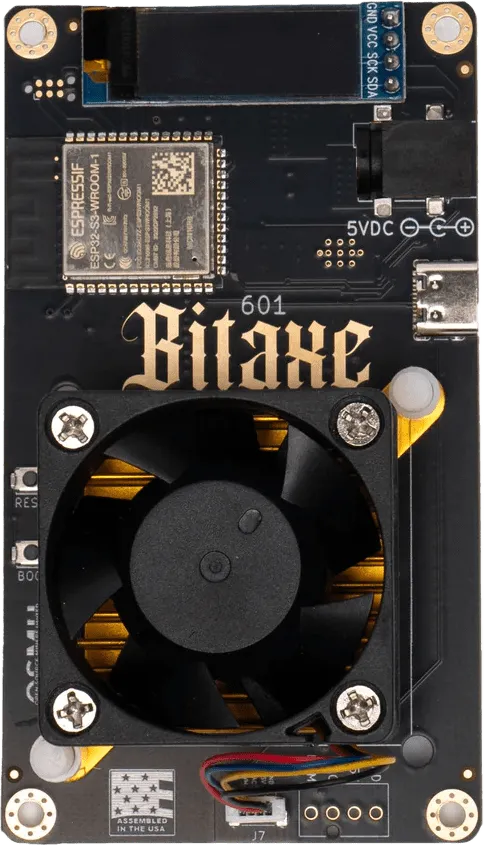
| Bitaxe Gamma 601 | Bitcoin (SHA-256) | 1.2 TH/s | 17 W | 35 dB | $77.17 |
| Canaan Avalon Nano 3S | Bitcoin (SHA-256) | 6 TH/s | 140 W | 40 dB | $216.11 |
| IceRiver KS0 Ultra | Kaspa (kHeavyHash) | 400 GH/s | 100 W | 35 dB | $112.00 |
| Goldshell Mini-DOGE III | Dogecoin and Litecoin (Scrypt) | 700 MH/s | 400 W | Not listed | $280.00 |
| IceRiver ALPH AL0 | Alephium (Blake3) | 400 GH/s | 100 W | Not listed | $179.00 |
| IceRiver ALEO AE0 | Aleo (zkSNARK) | 60 MH/s | 100 W | Not listed | $154.00 |
Be realistic about what a small unit does. A Bitaxe or Avalon Nano pointed at a solo pool is a lottery ticket: its chance of finding a Bitcoin block on its own is small, and most such devices will never find one. Run your own numbers with our solo mining calculator. On a regular pool, a small unit receives a correspondingly small share.
Can you still mine crypto with a CPU or GPU?
For Bitcoin, not in any practical sense. The Bitcoin white paper describes proof of work as “essentially one-CPU-one-vote,” and early Bitcoin was mined on ordinary computers. Today, SHA-256 mining is done by ASICs rated in terahashes per second, and the network’s total hashrate is so large that a CPU or graphics card contributes a negligible share while still drawing real power. The same is true for Litecoin, Dogecoin, Kaspa and the other ASIC-dominated coins in the table.
Some coins were designed to resist ASICs. Monero adopted RandomX in its November 30, 2019 network upgrade (release 0.15). The Monero project describes RandomX as optimized for CPUs, with the goal of discouraging specialized hardware. Desktop CPUs therefore still mine Monero. At the same time, RandomX ASICs now exist: the Antminer X9 is listed at 1 MH/s and 2,472 W, at $5,449.00, Bitminers price at the time of writing (October 5, 2026). Whether that changes Monero’s design goals is a matter for the Monero community; for a buyer, it simply means both CPUs and dedicated hardware are options.
What to check before choosing a coin to mine
- Algorithm lock-in. An ASIC mines only its algorithm. A Scrypt miner cannot switch to Bitcoin, and a SHA-256 miner cannot switch to Kaspa. Choose the coin, then the algorithm, then the machine.
- Power and wiring. Small units run on a standard outlet. Full-size ASICs usually draw several thousand watts, and many are rated for 200-240 V input, so they typically need a dedicated 240 V circuit. Check the listed power before you buy.
- Noise. Listed noise ranges from 35 dB for the smallest units to 75 dB or more for full-size air-cooled machines, which belong in a garage or outbuilding, not a living room.
- Pool availability. Most miners join a pool so that payouts arrive in small, regular amounts. Confirm that established pools support the coin before buying hardware for it.
- Network changes. Protocols change. Ethereum left proof of work entirely, and Monero changed algorithms specifically to affect which hardware works. Follow the official channels of the coin you plan to mine.
- Your own numbers. Coin prices, network difficulty and electricity rates move constantly. Convert units with the hashrate converter and work through costs with our ASIC miner profitability guide. Bitminers does not guarantee mining profitability.
Frequently asked questions
What crypto can you mine?
Any proof-of-work coin, as long as you have hardware for its algorithm. Common examples are Bitcoin (SHA-256), Litecoin and Dogecoin (Scrypt), Kaspa (kHeavyHash), Ethereum Classic (Etchash), Zcash (Equihash), Alephium (Blake3) and Monero (RandomX). Proof-of-stake coins such as Ethereum and Cardano cannot be mined.
What is the easiest crypto coin to mine?
The easiest to start with is a coin that has small, low-power hardware: for example, a Bitaxe or Avalon Nano for Bitcoin, or an IceRiver KS0 Ultra for Kaspa. They plug into a normal outlet and are set up through a web page. Easy to start does not mean higher output; small units produce small results.
Can you still mine Ethereum?
No. Ethereum moved to proof of stake in The Merge on September 15, 2022, and validators now produce its blocks. Etchash hardware can mine Ethereum Classic instead.
Can you still mine crypto at home?
Yes. Small units from 17 W to a few hundred watts run from a household outlet, and some full-size machines run at home if you have a suitable circuit and a place where 75 dB of noise is acceptable. Check local electricity rates and rules first.